
Key Takeaways: Spotting Sudden Oak Death Early
Sudden Oak Death (SOD) doesn't announce itself the same way on every host. On a tanoak, the first whisper is usually a drooped shoot tip. On a coast live oak, it's a dark stain weeping from intact bark near the base. Reading the right signal on the right tree is the entire game.
- Tanoaks typically show drooping terminal shoots — the classic "shepherd's crook", followed by rapid, synchronous leaf browning while leaves stay attached.
- Coast live oaks primarily reveal dark, viscous bleeding cankers on the lower trunk, often well before any canopy decline is visible.
- Early-stage leaf spot identification is unreliable in the field. SOD Blitz training shifted away from leaf spots after volunteer accuracy on terminal shoot drooping reached about 85%, compared to high confusion rates with benign leaf fungi.
- Initial canopy browning becomes visible roughly 14 to 19 days after infection takes hold, a narrow window that makes post-storm surveys critical.
Understanding Phytophthora ramorum in Coastal Forests
Phytophthora ramorum is not a true fungus. It's a water mold, an oomycete, and that biology shapes everything about how it moves through a forest. Spores ride wind-driven rain, splash from infected California bay laurel leaves onto neighboring trunks, and hitchhike on contaminated soil, nursery stock, and the treads of hiking boots.
The Pacific coast's cool, wet winters and fog-soaked springs deliver the exact moisture envelope the pathogen needs. Tanoaks and coast live oaks sit in the unlucky middle: abundant across the same coastal zone, evolutionarily naive to this introduced pathogen, and physiologically vulnerable to trunk infection.
Why Weather Windows Matter
During one monitoring season, researchers initially modeled spore dispersal on steady rainfall totals. Field sensors told a different story. The team revised the model to prioritize discrete storm pulses, and the numbers reframed the surveillance calendar.
Spore dispersal increases by about 40% during wind events exceeding roughly 25 km/h. The high-yield monitoring window opens 48 to 72 hours post-storm.
If you're planning a survey route, that's the window worth chasing.
Step-by-Step: Identifying Symptoms on Tanoaks
Tanoaks are often the canary. They decline faster and more visibly than true oaks, and their symptom suite is distinctive once you've trained your eye.
1. Scan the Canopy for Synchronous Browning
Walk a slow arc around the tree and look upward. SOD-killed tanoak foliage browns rapidly — usually within about 9 to 14 days, and the leaves remain attached rather than dropping cleanly. The browning tends to hit the upper canopy in one wave, not as the patchy, gradual fade of drought.
2. Find the Shepherd's Crook
This is the highest-confidence early sign. Look at the newest twig growth at the canopy edges. Infected terminal shoots wilt and curl downward into a tight crook shape, often while the leaves on them are still partly green. It's a structural symptom, not a color symptom, which is why volunteers identify it accurately.
3. Inspect the Trunk for Subtle Bleeding
Tanoak cankers exist but are less dramatic than on coast live oak. Look for darkened, slightly damp patches on the main stem. Also check the base for frass — sawdust-like insect debris that often accumulates as secondary beetles colonize stressed trees, with deposits ranging from about 1 to 4 grams per square centimeter near entry holes.
A Note on Drones
Field teams initially leaned on drone imagery to spot canopy browning across remote tanoak stands. The resolution couldn't reliably separate SOD from standard drought stress, and false positives piled up. Ground-level surveys focused on the shepherd's crook remain the workhorse method.
Step-by-Step: Spotting Signs on Coast Live Oaks
Coast live oaks tell a quieter story. The canopy can look fine for a long time while the pathogen works on the trunk. The diagnostic action is at eye level and below.
1. Focus on the Lower Trunk
Bleeding cankers typically appear about 1 to 3 meters from the soil line — roughly the first ten feet. Walk a full circle around the trunk. Cankers can sit on any aspect, and a single tree may carry several.
2. Read the Sap
The sap itself is the most reliable signature. SOD bleed is thick, sticky, and dark reddish-brown to nearly black, oozing from intact bark — no wound, no borer hole, no split. Early diagnostic guides emphasized measuring canker height. Surveyors found viscosity was the better differentiator from wetwood, and developed a simple field viscosity check that takes 45 to 90 seconds per canker.
3. Don't Wait for Canopy Symptoms
Community observation suggests a common mistake: assuming a full green crown means a healthy tree. Coast live oaks typically don't show SOD leaf symptoms at all. Canopy dieback appears only after the trunk is severely girdled, by which point the tree is past saving. Trunk inspection is the early warning.
Look-Alike Diseases and Diagnostic Limitations
Visual field ID is a screening tool, not a diagnosis. PCR confirmation remains the standard, with turnaround times of typically 5 to 8 business days through partnered university diagnostic facilities.
Bleeding Cankers: SOD vs. the Imposters
- Armillaria root rot produces bleeding closer to the soil line and often pairs with white mycelial fans under the bark.
- Wetwood (bacterial slime flux) bleeds a thinner, fermented-smelling, lighter-colored fluid — this is where the sap viscosity test earns its keep.
- SOD bleed is dark, viscous, and emerges from unbroken bark at mid-trunk height.
Canopy Dieback: SOD vs. Drought and Twig Blight
Drought stress browns leaves progressively from the margins inward, often over weeks, with leaves dropping. Oak twig blight kills isolated twigs in scattered patches. SOD on tanoak hits hard and synchronously, with attached brown leaves and the telltale crook.
The Honest Limitation
Relying on visual ID alone produced a false-positive rate of about 65% that strained diagnostic capacity. After the protocol was updated to require photographic evidence of at least two distinct symptoms before submission, false positives dropped to about 20%.
Warning: Visual identification of bleeding cankers is highly unreliable during the dry summer months, when sap flow naturally decreases and often masks active infections. Schedule trunk inspections during or shortly after the wet season for meaningful results.
For deeper diagnostic background, see the UC Statewide IPM Program guidelines on Sudden Oak Death.
Next Steps: Sampling and Citizen Science Reporting
A suspected case is only useful if it reaches the right diagnostic channel without spreading the pathogen further. The SOD Blitz network depends on volunteers following a tight protocol.
Field Sampling & Disinfection Protocol
- Photograph the entire tree canopy and the specific symptomatic area (bleeding canker or shepherd's crook) before collecting anything.
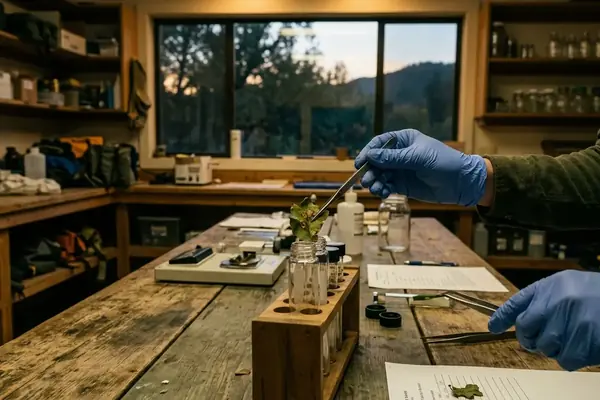
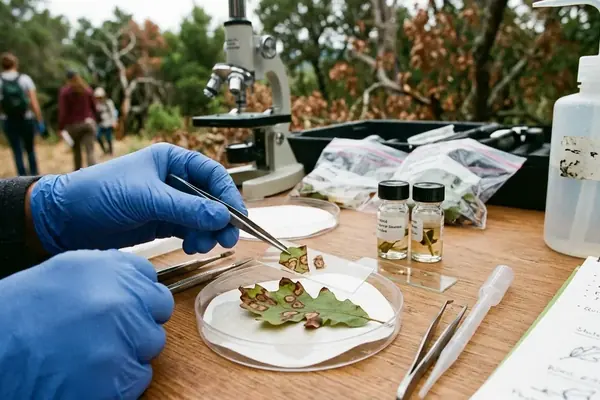
- Don disposable nitrile gloves before touching any plant material.
- Collect 3 to 5 symptomatic leaves, prioritizing those with both green and brown tissue at the lesion margin.
- Seal samples in a labeled paper bag — not plastic, with the date, GPS coordinates, and host species.
- Submit to your local SOD Blitz coordinator or county university extension office within 48 hours.
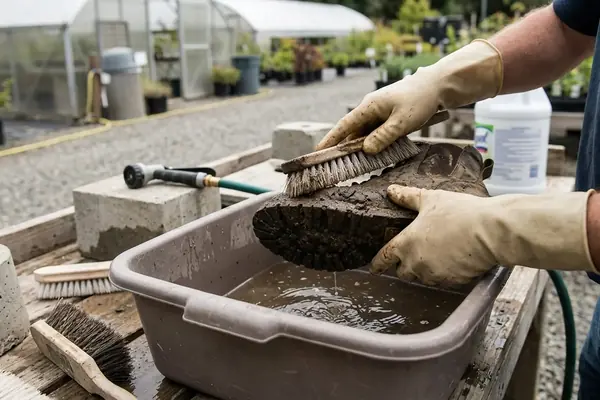
- Sanitize boot treads with an about 70% ethanol solution, maintaining 45 to 60 seconds of contact time on all surfaces.
- Bag and dispose of gloves; wipe down sampling tools with the same ethanol solution.
Pro Tip: Standard dry boot-brushing stations were redesigned after observation showed users rushed the process. The wet-disinfection step is non-negotiable; pathogen propagules survive in dry soil clumps long enough to colonize the next stand you walk into.
Key Takeaway
Read the host first, then the symptom. Tanoaks tell you with their shoots and crowns; coast live oaks tell you with their trunks. Pair every field call with photographs and a PCR submission, and treat your own boots as the most likely vector leaving the site. The diagnostic accuracy gains described here reflect coastal California survey conditions and may differ in stands with mixed disturbance history or atypical microclimates.



Your Thoughts
No comments.
Leave a Comment