
Contents
- Executive Summary: Key Takeaways for Landowners
- Understanding Phosphonate Treatments and Tree Immunity
- Scope and Limitations: Assessing Your Oaks for Treatment
- Step-by-Step Application Methods: Bark Spray vs. Injection
- Optimal Timing and Frequency of Applications
- Safety Protocols and Environmental Considerations
Executive Summary: Key Takeaways for Landowners
Phosphonate treatment belongs in the prevention toolbox, not the rescue toolbox. Brendan O’Malley has seen the confusion up close: a landowner notices bleeding on a coast live oak, reads that phosphonate helps with Sudden Oak Death, and asks whether one application can turn the tree around.
That is the wrong moment to start.
Initial field trials attempted to use phosphonates as a curative measure on trees with active bleeding cankers, but mortality rates remained high. The protocol shifted to prevention because the treatment performs best before Phytophthora ramorum has gained a foothold. In asymptomatic trees, application about three weeks before peak seasonal spore dispersal was associated with about 85% efficacy.
Key Takeaway: Treat healthy, uninfected oaks in high-risk settings. Do not wait for advanced Sudden Oak Death symptoms and expect phosphonate to work as a cure.
For landowners, the practical choice usually comes down to two delivery methods: topical bark spray or direct trunk injection. Bark spray avoids drilling, but it depends heavily on dry weather and correct surfactant use. Micro-injection places the material directly into the xylem, but it creates wounds that the tree must compartmentalize.
Our experience showed that the best candidates are not simply the biggest trees. They are healthy trees with clear site, habitat, or cultural value, especially when they stand near known disease pressure.
Understanding Phosphonate Treatments and Tree Immunity
A common question from landowners is simple: does phosphonate kill the Sudden Oak Death pathogen?
The better answer is more interesting. Researchers initially hypothesized that phosphite ions directly attacked Phytophthora ramorum cell walls. Subsequent xylem fluid assays pointed in a different direction. The compound acts as an elicitor, meaning it stimulates the tree’s own defense signaling rather than functioning like a contact disinfectant.
How Systemic Acquired Resistance Works
Systemic Acquired Resistance, often shortened to SAR, is the tree’s internal alert system. Once triggered, the tree begins preparing tissues beyond the original treatment zone. In practical terms, phosphonate helps the oak respond faster if spores land during the wet infection window.
The concentration matters. Research from xylem fluid work indicates that about 20 to 25 parts per million of phosphite concentration is required in xylem fluid, with 11 to 16 days needed for SAR to fully activate after application. That delay is why a treatment made during a storm cycle is poor timing. The tree needs lead time.
During practice, Brendan treats phosphonate less like an emergency medicine and more like seasonal preparedness. If spore dispersal is already underway, the calendar is working against the tree.
Academic Sources
Foundational university forest pathology research has helped clarify why timing and tree condition matter. For readers who want to follow the science behind oak disease monitoring and pathogen biology, the UC Berkeley Forest Pathology and Mycology Laboratory is a useful starting point.
Scope and Limitations: Assessing Your Oaks for Treatment
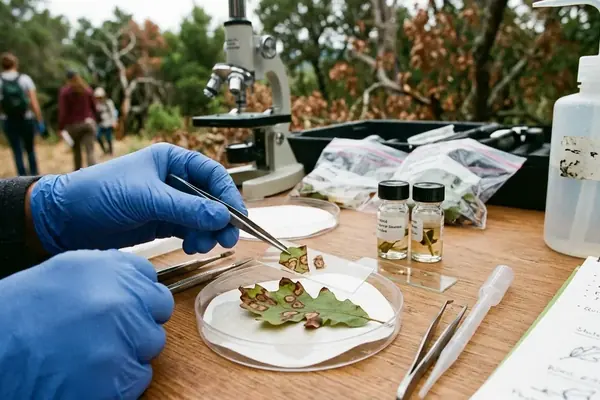
Begin with the tree, then look outward. A healthy Coast Live Oak, Tanoak, or Black Oak in a high-risk area deserves a closer look than a declining tree with advanced symptoms. Phosphonate cannot save trees already showing severe bleeding cankers, marked crown dieback, or other late-stage indicators of Sudden Oak Death.
That limitation can feel harsh. It is also what keeps treatment decisions honest.
Survey the Property Before Choosing Trees
Walk the property after a wet period, when disease pressure is easier to read. Note healthy oaks first. Then look for heavily infected bay laurels or other nearby disease reservoirs. The standard proximity rule came from mapping spore dispersal around infected bay laurels; wind-tunnel and field tracking showed about a 95% drop in viable spore transmission beyond a roughly 140-foot radius.
Moisture still governs risk. Optimal spore germination requires 3 to 5 days of continuous leaf wetness, so shaded, damp draws deserve more attention than exposed ridgelines with fast drying bark.
Warning: The proximity assessment changes on steep ground. On properties situated on slopes steeper than about 20 degrees, waterborne spore runoff can extend the danger zone significantly downhill.
Prioritize High-Value Landscape Trees
Community observation suggests that landowners make better treatment decisions when they rank trees before calling a crew. Put each candidate into one of three groups: healthy and high-value, healthy but lower priority, or symptomatic and needing diagnosis rather than prevention.
High-value does not always mean ornamental. It may mean a mature oak shading a home, stabilizing a slope, anchoring wildlife habitat, or holding family significance. The treatment window is narrow, so clarity helps.
Step-by-Step Application Methods: Bark Spray vs. Injection
The beginner’s path usually starts with bark spray because it is non-invasive. The advanced path, used when site rules or weather make spraying unsuitable, is micro-injection. Neither method rewards guesswork.

Topical Bark Spray Method
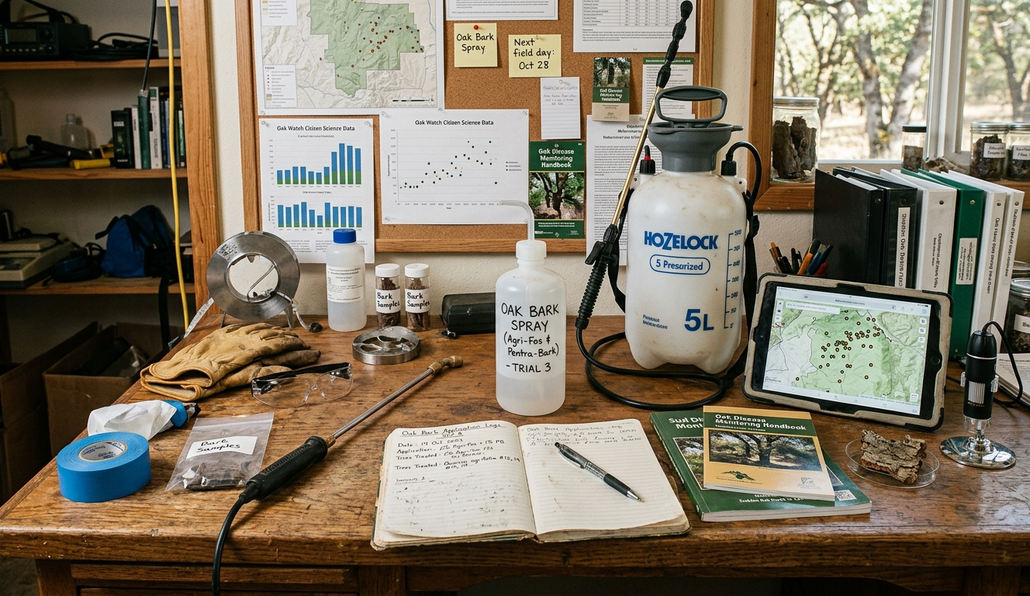
For bark spray, phosphonate is mixed with an organosilicate surfactant such as Pentabark. The surfactant helps the solution move through the bark and into living tissues. Without that penetration step, the application remains mostly on the surface.
- Confirm that the tree is asymptomatic and appropriate for preventive treatment.
- Choose a dry-weather window and inspect the bark for surface moisture.
- Prepare a pump sprayer, chemical-resistant gloves, eye protection, long sleeves, and label-compliant respiratory protection when required.
- Mix phosphonate and surfactant according to the product label and site prescription.
- Spray the lower trunk evenly until runoff begins, then stop. More runoff does not mean better uptake.
Application volume has a practical range. Field data indicate about 2 to 2½ liters of spray mixture per meter of trunk circumference. That figure helps crews avoid both under-coverage and waste.
Micro-Injection Method
Micro-injection delivers phosphonate directly into the xylem through small drilled ports and specialized syringes. It reduces weather dependency, but the wound is real. Early DACH-region forestry trials heavily favored micro-injection; longer observation showed that repeated drilling caused compartmentalization wounds in certain oak species.
The optimal micro-injection hole diameter is about 4 to 5 millimeters. That small range matters because oversized holes increase injury, while undersized ports may not seat equipment properly.
Application Method Comparison Matrix| Parameter | Topical Bark Spray | Micro-Injection |
|---|---|---|
| Vascular Damage Risk | None when non-invasive | Moderate; requires drilling into xylem |
| Weather Dependency | High; requires a dry post-application window | Low; less dependent on bark surface conditions |
Optimal Timing and Frequency of Applications
Timing is where good intentions often go sideways. A tree may look ready to treat, but the bark, sap flow, canopy stage, and forecast all matter.
The two practical windows are fall, after acorn drop and before heavy rains, or spring, after leaves have fully emerged. Applying phosphonate bark spray during active sap flow in early spring resulted in about a 65% chemical rejection rate, with surfactant pooling at the root flare rather than absorbing into vascular tissue.
Weather Constraints for Bark Spray
Bark spray needs dry bark at application and at least 48 hours without rain afterward. In treatment timing observations, crews planned around 50 to 55 hours of completely dry weather after bark spray to protect uptake.
Pro Tip: If the forecast is marginal, wait. A missed dry window is usually less costly than a rushed application that washes into soil or drains.
Long-Term Treatment Schedule
The maintenance interval changed as leaf tissue data improved. Annual treatments produced localized phytotoxicity and leaf burn in test plots, so schedules moved toward an initial application, a booster in about 6 months, and then maintenance every 1 to 2 years.
The ideal long-term maintenance interval is about 18 to 24 months. Field feedback indicates that calendar reminders help, but tree condition and seasonal disease pressure still guide the final decision.
Safety Protocols and Environmental Considerations
Phosphonate work happens at the base of living trees, often near homes, creeks, native understory plants, and drainage paths. That is why the safest application is not only about the person holding the sprayer.
Personal Protective Equipment
Use chemical-resistant gloves, eye protection, long sleeves, long pants, closed footwear, and any respiratory protection required by the product label. Keep mixing equipment stable and away from storm drains, bare soil channels, and children’s play areas.
Label directions control the job. If the property owner cannot follow them comfortably, hiring an ISA Certified Arborist or a properly licensed applicator is the more responsible choice.
Runoff and Local Rules
Preventing runoff into local waterways is part of disease prevention. Runoff monitoring in stricter environmental frameworks comparable to DACH water protection regulations led to modified techniques near watersheds. A roughly 15-meter minimum buffer zone from seasonal creeks or drainage ditches should guide planning, and the compound’s half-life degradation in standard loamy soils runs about 75 to 85 days.
In regions with strict groundwater protection laws similar to DACH environmental frameworks, trunk injection is legally prioritized over bark spray if the oak sits within about 15 meters of a seasonal watershed to reduce surfactant runoff.
Check local regulations before applying chemicals on private land. Some jurisdictions distinguish between homeowners treating their own trees and paid applicators treating trees for others.
Within the narrow SOD-prevention window this guide covers, phosphonate treatment can be a practical conservation tool. It works best when the tree is still healthy, the timing is deliberate, and the application method fits the site rather than the other way around.






Your Thoughts
No comments.
Leave a Comment