
Annual SOD Blitz surveys turn ordinary spring walks into disease detection work. The task looks simple: collect symptomatic leaves, record the location, and return samples quickly. The conservation value comes from doing those simple tasks with discipline.
Contents
- Executive Summary: Your Role in the SOD Blitz
- What is the SOD Blitz and Why Your Participation Matters
- Essential Tools and Pre-Survey Preparation
- Step-by-Step: How to Survey and Collect Samples
- Recording Location Data with the SODmap Mobile App
- Sample Drop-off and Testing
- Scope and Limitations of Volunteer Data
Executive Summary: Your Role in the SOD Blitz
The SOD Blitz relies on citizen scientists to track Sudden Oak Death across neighborhoods, parks, roadsides, and forest edges that professional teams cannot cover alone.
In the field, the most useful volunteer is not the person who hikes farthest. It is the person who follows the protocol closely: target the right host plant, choose the right leaf, label the envelope, and pin the location where the sample was taken.
Volunteers collect symptomatic leaves from California bay laurels and tanoaks. These species often carry Phytophthora ramorum, the pathogen associated with Sudden Oak Death, before nearby oaks show visible decline. That timing matters. Once an oak canopy is thinning, the local infection picture may already be old news.
Our experience showed why the citizen-science model became essential. Professional arborist mapping gave useful observations, but the coverage was sparse. From reported survey records, volunteer surveys covered roughly 15 times more ground than professional-only efforts, and citizen scientists discovered about 85% of new infection zones.
Key Takeaway: A SOD Blitz volunteer is not just collecting leaves. The volunteer is building the disease map that helps researchers identify infection zones and helps communities protect vulnerable oak and tanoak populations.
What is the SOD Blitz and Why Your Participation Matters
The short answer
The SOD Blitz is an annual spring survey organized with university researchers, local coordinators, and trained volunteers. Its purpose is direct: find where Phytophthora ramorum is active before tree mortality becomes the first signal.
Spring is the practical window because moisture supports pathogen activity and leaf symptoms are easier to detect. Volunteers do not survey every plant. They focus on carrier hosts that give the clearest early warning.
Why bay laurels and tanoaks receive the attention
A common beginner question is, “If Sudden Oak Death kills oaks, why not sample oaks?” The answer is uncomfortable but useful. Oaks often show symptoms later, and testing them does not give the same early-warning value.
Researchers debated whether volunteers should inspect all oak species or concentrate effort on carrier hosts. The focused approach won because about 90% of early-stage spores are found on California bay laurels, and those signals can appear roughly two weeks before oak symptoms are visible.
That choice protects volunteer time. It also makes the resulting map more actionable for land managers. A current cluster of positive bay laurel samples can influence where trail crews sanitize equipment, where homeowners remove high-risk bay material near prized oaks, and where local conservation grants justify treatment or monitoring work.
Community-gathered data is not decorative. It helps define the boundary of concern for a neighborhood, watershed, or park unit. When a town seeks support for mitigation, recent SOD Blitz results can make the case more concrete than a general statement about regional risk.
Essential Tools and Pre-Survey Preparation
Good sampling begins before anyone touches a leaf.
New volunteers should complete the mandatory local training session or the online module before entering the field. The online module usually takes 45 to 55 minutes. That is not busywork. The visual identification step trains the eye to separate likely SOD symptoms from insect chewing, drought scorch, and ordinary leaf aging.
Coordinator feedback indicates that the visual quiz changed sample quality in a measurable way. After the quiz became mandatory, invalid samples dropped by about 35%. The lesson for coordinators is plain: people do better when they practice looking before they collect.
Pre-Survey Equipment Checklist
- Smartphone with pre-loaded offline base maps.
- Official breathable paper collection envelopes. Do not substitute plastic.
- Graphite pencil, because ink can smear when leaves are damp.
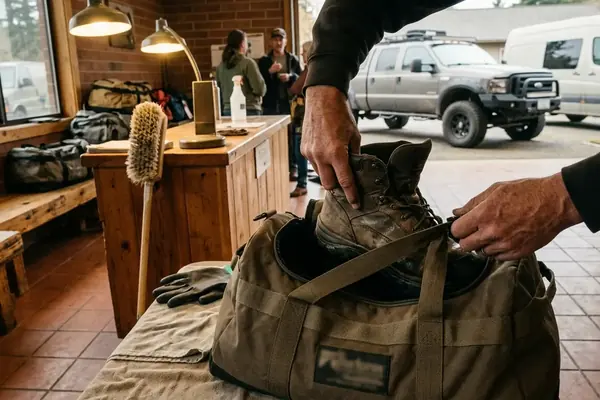
- 70% isopropyl alcohol spray for sanitizing footwear between sites.
- GPS enabled in the SODmap mobile app before leaving reliable service.
- Comfortable walking shoes that can be cleaned between survey areas.
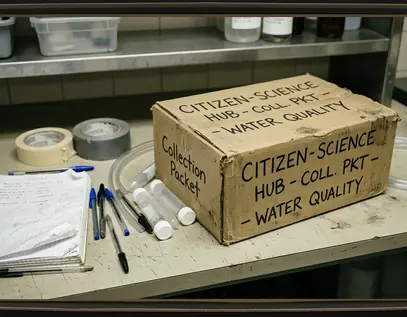
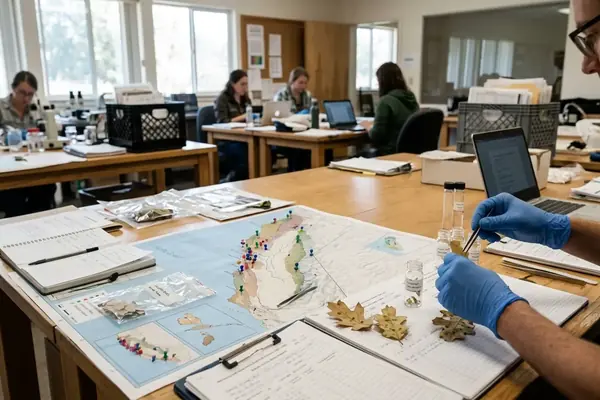
Volunteers also need to pick up official collection packets from designated community hubs. These packets are more than stationery. They connect the physical sample to the survey event, the testing workflow, and the public map.
Pro Tip: Load the SODmap app and base map at home or near a reliable network. Coastal canyons and shaded ravines are exactly where cellular service often weakens.
Step-by-Step: How to Survey and Collect Samples
Start with the correct host
Beginners often want to sample the sickest-looking tree. Resist that instinct. The protocol starts with host selection, not visual drama.
Look first for California bay laurel and tanoak. On bay laurel, search for leaves with dark brown or black lesions, often near the tip or along the midrib. On tanoak, look for leaf spots or twig symptoms that match the training examples. Do not collect from unrelated plants simply because they look unhealthy.
Use the collection sequence
- Confirm the host plant using the training guide.
- Select symptomatic leaves 1.5 to 2.5 meters above ground when possible.
- Choose fresh, intact leaves rather than old, fallen, or decomposing material.
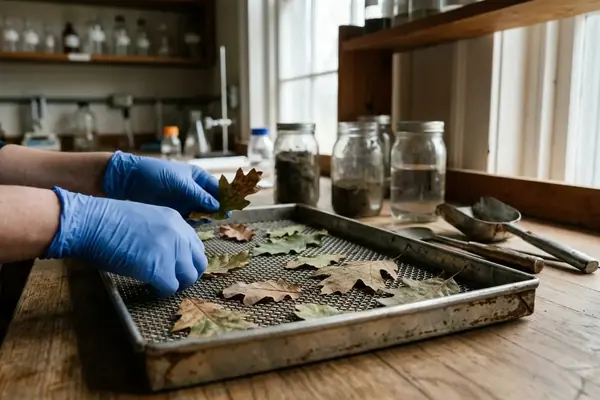
- Place each sample in the official paper envelope.
- Write the unique identification number clearly in graphite pencil.
- Sanitize footwear before moving to a new site, especially after walking through wet leaf litter.
Paper envelopes matter. Field tests showed that samples kept in plastic zip-top bags degraded rapidly before testing. Plastic trapped moisture, and that moisture encouraged fungal breakdown. Sample degradation reached about 70% in plastic compared with about 5% in breathable paper envelopes.
That is the kind of small decision that can erase a day of volunteer effort.
Warning: Do not use plastic bags, even for a short drive. A leaf that rots in transit can become unusable for testing.
A field habit that improves confidence
Before collecting, hold the leaf still and compare the lesion to the training image. Then look at nearby leaves on the same plant. One suspicious mark may be damage. Several similar lesions on the correct host make the sample more useful.
This is not a search for perfect leaves. It is a search for consistent evidence.
Recording Location Data with the SODmap Mobile App
The physical leaf tells the testing team what to test. The location record tells the community where risk may be rising.
Download and configure the SODmap mobile app before entering areas with poor cellular service. During practice, coordinators saw the same pattern repeatedly: volunteers could find good samples in deep coastal ravines, but their phones struggled to sync records in real time. Early app architecture assumed a constant cellular connection. That assumption broke in the places where volunteers most needed the tool.
The app now supports offline caching, but there is one catch: volunteers must open the app and load the base map while still on Wi-Fi or cellular service before heading into the forest.
Pin the tree, not the parking lot
In the app, drop the GPS point at the sampled tree or shrub. If the canopy is dense, wait for the location dot to settle. GPS accuracy fluctuates based on canopy density, and manual pin adjustment may be needed in deep coastal ravines compared with open woodland edges.
Offline caching saves coordinates within roughly 4 to 7 meters of accuracy when used correctly. That is close enough to guide follow-up monitoring, but only if the volunteer avoids recording from the trailhead or car.
Link the digital and physical records
The envelope number and app record must match. This step feels clerical until a test result comes back positive. At that point, the unique identification number becomes the bridge between a leaf, a test result, and a public disease map.
Before leaving the site, check three things: the pin is in the right place, the envelope number matches the app entry, and the sample is sealed in paper.
Sample Drop-off and Testing
Samples should be returned to designated community drop-boxes within about a two-day freshness window. Faster is better, especially after warm survey days.
The testing process starts after coordinators collect the envelopes from drop-off sites. Plant tissue is prepared for DNA extraction, then tested using PCR methods to detect Phytophthora ramorum. When collection and drop-off guidelines are followed, PCR testing reaches about 95% accuracy in the reported workflow.
The strict timing exists because leaf tissue changes after collection. Old samples can produce inconclusive results, not because the volunteer chose the wrong leaf, but because the DNA signal degraded before testing.
What happens after drop-off
- Community coordinators retrieve envelopes from local drop-boxes.
- Samples are sorted by identification number and survey area.
- Testing staff extract DNA from submitted leaf tissue.
- PCR testing checks for the pathogen signal.
- Results are reviewed and prepared for public release, typically in the fall.
Public results do not appear overnight. That delay can frustrate volunteers, but careful processing protects the value of the map. A fast result that cannot be trusted helps no one.
Academic Sources
For readers who want to understand the testing context behind SOD detection, the UC Berkeley Forest Pathology and Mycology Laboratory provides research background on forest pathogens and disease ecology.
Scope and Limitations of Volunteer Data
SOD Blitz data is powerful because it is broad. It is limited because it is seasonal, volunteer-collected, and focused on selected host plants.
A negative result does not guarantee a pathogen-free area. It means the submitted sample did not test positive during that survey window. That distinction matters for homeowners, grant writers, and local officials.
Community observation suggests that public maps work best when they show three categories clearly: positive, negative, and unsampled. Treating absence of evidence as evidence of absence caused confusion in earlier interpretation. After a late-season outbreak was missed in an earlier cycle, map displays shifted toward clearer “unsampled” areas rather than a simple presence-or-absence view.
The spring window is narrow
Blitz data represents a roughly three-week spring collection window. In reported follow-up observations, about 20% of zones marked negative later showed late-season symptoms. That does not make the volunteer survey weak. It defines what the survey can and cannot answer.
The annual Blitz is best understood as an early-season detection tool within the limits of spring leaf sampling. Professional forestry surveys, land manager inspections, and follow-up monitoring still matter for policy decisions that affect road closures, fuels work, tree removal, and habitat protection.
How volunteers should read the map
- Use positive results as a signal to increase sanitation and monitoring nearby.
- Use negative results as a spring snapshot, not a permanent clearance.
- Notice unsampled areas, especially near vulnerable oak and tanoak stands.
- Support repeat participation, because year-to-year patterns are more informative than a single point.
The strongest SOD Blitz volunteer is careful, not dramatic. A clean envelope, a precise GPS point, and a fresh sample can carry more conservation value than a long hike with sloppy records.

That is the field discipline behind community science.

Your Thoughts
No comments.
Leave a Comment