Late August, a wooded parcel on a shaded lower slope. The owner walks the same loop she has walked for a decade, and this time a mature coast live oak stops her: every leaf in the crown has gone the color of paper bag. Brittle, uniform, hanging on. Three weeks earlier the tree read as unremarkably healthy.
That collapse window is real and it is fast. Canopy browning in coast live oak runs its course in roughly 14 to 21 days once it begins, typically in the heat of late summer. What it is not is the beginning of anything.
The Phytophthora ramorum infection driving that browning generally predates the visual shift by 24 to 36 months. The tree spent two to three growing seasons losing conductive tissue while presenting a full green crown to anyone looking up. "Sudden" describes the last two weeks of a multi-year decline, and that single word has probably cost more oaks than any other factor in residential disease ecology. Owners wait for a symptom that only appears after the tree is unsalvageable.
What the Pathogen Does Beneath the Bark
Infection starts with water, not wind damage or soil contact. Spores washing off overhead hosts land on the trunk surface, and establishment requires free moisture sitting on the bark for something on the order of 48 to 72 consecutive hours. A single afternoon shower does nothing. A stalled winter storm system over a fog-pocketed canyon does a great deal.
Once the pathogen breaches the outer bark, it colonizes the phloem and the outer cambium, killing tissue laterally. During active growth phases, canker margins advance at roughly 1 to 3 centimeters per month. Run that arithmetic on a trunk with a circumference of somewhere around one meter and the multi-year timeline stops being abstract: girdling a mature stem takes years of patient expansion, all of it hidden under intact bark that looks entirely normal from two paces away.
Throughout that period the oak functions as a silent host, and the surrounding stand keeps receiving inoculum from the true sporulating reservoir in California bay laurel foliage. The University of California Statewide Integrated Pest Management Program maintains current host and symptom guidance worth checking against local conditions before any treatment decision.
Why a Green Canopy Proves Nothing
Oaks are generous with their own reserves. A coast live oak can hold a full, green, apparently vigorous canopy with up to two-thirds of its vascular cambium already compromised by cankering. The remaining third moves enough water to meet demand in a normal spring. The tree is not compensating for stress so much as operating on the last functional third of its plumbing.
Latency duration resists generalization. It tracks localized soil drainage profiles and the specific oak species involved; coast live oaks rooted in well-drained upland soils may mask symptoms for an additional season compared with the same species in a riparian corridor, where saturated winter soils and higher inoculum pressure compress the sequence. Two trees an estimated 200 meters apart on one property can sit at entirely different points on the same curve.
The trigger for visible collapse is hydraulic, and it is usually drought. When soil moisture drops below the permanent wilting point for in the range of 10 to 14 consecutive days during peak summer heat, transpirational demand from the canopy exceeds what the surviving vascular tissue can supply. The crown browns. Homeowners blame the dry year. The dry year only revealed arithmetic that had been true since the second winter of infection.
What Green Crowns Hide
Crown color is a lagging indicator in this disease, roughly two to three years behind the biology. Assess risk from the trunk and from the bay laurel inventory around the tree, not from the canopy.
Treating Trees That Still Look Fine
Early management protocols leaned heavily on canopy pruning to open airflow, on the reasonable assumption that drier foliage meant less infection. Field observation retired that approach: thinning the crown did nothing to slow basal canker progression, because the cankers were never a canopy problem. Pruning also opened wounds and removed photosynthetic capacity from trees already short on reserves.
Current practice inverts the target. Preventative phosphonate trunk treatments go into asymptomatic oaks during the fall application window, roughly October through December, ahead of the wet-season infection period. Priority goes to asymptomatic oaks within an approximately 50-meter radius of confirmed California bay laurel hosts, since that is the realistic inoculum envelope.
This is the practical payoff of rethinking the timeline. A slow infection rate means a wide intervention window, and the window sits entirely inside the period when the tree still looks healthy. Waiting for canopy symptoms converts a management decision into a removal decision.
Fall Injection Priority
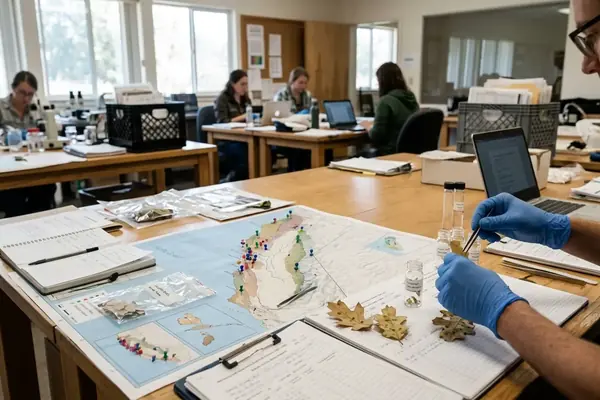
Map your bay laurels first, then draw 50-meter buffers. Oaks inside those buffers are your October-to-December treatment list, regardless of how good they look.
Walking the Lower Trunk: A Repeatable Inspection Routine
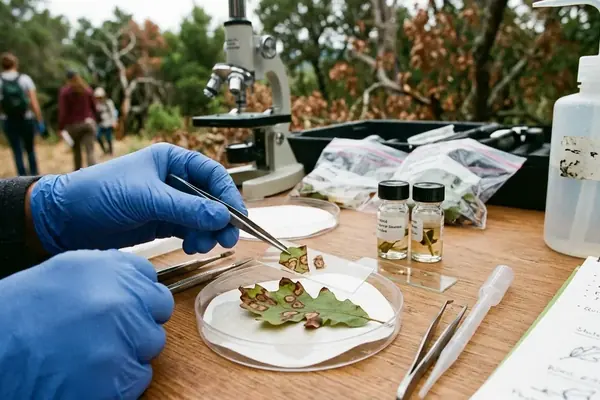
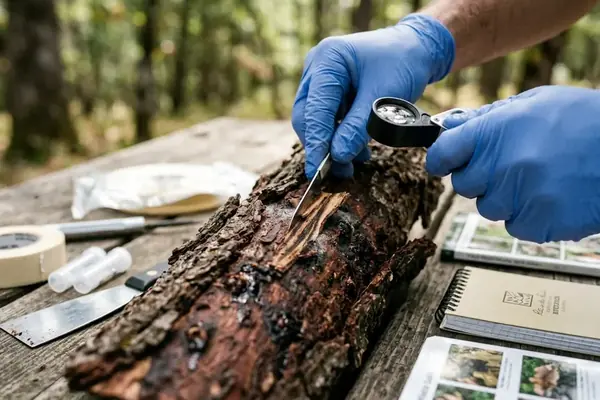
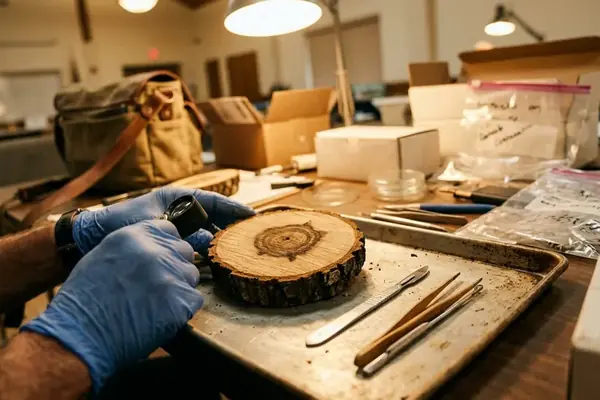
The inspection I use on residential parcels takes about ten minutes per tree and needs no instruments beyond a hand lens and a rake. Field diagnosis of bleeding cankers is presumptive, since several Phytophthora species and unrelated wounds produce similar seeps; testing remains the only way to name the organism with certainty.
Clear the base. Rake and cut back basal vegetation, ivy, and leaf litter to expose the trunk up to 3 meters (about 10 feet) from the soil line. That band is the high-risk zone and the one most commonly hidden.
Scan for bleeding. Look for viscous, burgundy-to-black seeps emerging through unbroken bark, typically 1 to 2 meters above ground, most visible in spring and early summer. Absence of a wound is the diagnostic detail.
Check for secondary colonizers. Ambrosia beetle frass appears as fine boring dust in piles 1 to 2 millimeters across; Hypoxylon fruiting bodies show as charcoal-colored spheres 2 to 5 centimeters wide on the bark. Their arrival in that order signals advanced cambial death.
Inventory the neighbors. Record every bay laurel within 50 meters and note its leaf-tip lesions.
Boots, Blades, Tires
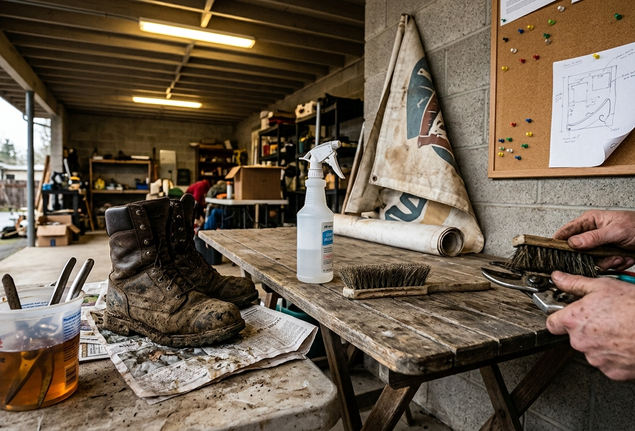
Spores travel in mud. Brush and disinfect tools and footwear between trees, and stay off infested ground during wet weather.
Work it through on a real parcel. Half an acre, three mature coast live oaks, a dense bay laurel thicket 30 meters upslope of the lot line. In May you rake the base of each oak to 3 meters and find nothing on Oaks 1 and 2; Oak 3 shows two burgundy seeps at roughly 1.4 meters, no wounding, no beetle frass, no Hypoxylon. All three oaks fall inside the 50-meter bay buffer, so all three go on the treatment list. You flag Oak 3 for testing and schedule phosphonate trunk injections for all three in early November, before the first sustained storms wet the bark for 48 hours straight. In January you remove the bay laurels within the buffer, working in dry weather, and re-inspect all three trunks the following May. Oak 3 may or may not hold. Oaks 1 and 2 were treated two seasons before anything would have shown in their crowns, which is the only moment the treatment was ever going to matter.



Your Thoughts
No comments.
Leave a Comment