
Contents
- How Sudden Oak Death Became a Seasonal Problem
- December to February: Wet Litter Wakes the Resting Spores
- March to June: Bay Laurel Leaf Tips Drive Oak Infection
- July to September: Dry Canopy, Dormant Pathogen, Open Work Window
- October to November: Phosphonate Timing and a Property Walk
How Sudden Oak Death Became a Seasonal Problem
When Sudden Oak Death first appeared in coastal California in the mid-1990s, the dying tanoaks and coast live oaks seemed to decline at random. A tree could look healthy in March and show a browned crown by September, with no obvious trigger. Decades of disease ecology work have since replaced that picture of year-round chaos with a fairly strict annual cycle. Foliar hosts such as California bay laurel drive that cycle, and the bleeding bark cankers on oaks arrive well behind it.
The early field record shows how misleading the trunk symptoms can be. Survey teams first tried to date infections by logging the day bleeding reddish-black sap appeared on coast live oak trunks. They dropped the method once inoculation experiments showed that bark cankers can take 6 to 24 months to break through the outer periderm after the spring spore event that started them. A bleeding oak in August therefore records an infection from a previous wet spring. Landowners who time sanitation cuts to the bleeding are reacting to an event that is already a year or two old.
Three seasonal windows now govern practical management:
- April through June: peak infection, and the best period for foliar sampling.
- July through September: the low-risk period for pruning, stand thinning, and fuel reduction.
- October through November: the window for preventative phosphonate applications before heavy rain.
That calendar belongs to California's Mediterranean climate, with its sharp spring surge and dry-summer halt. Coastal Oregon and Washington behave differently. Summer fog drip and persistent maritime rain on tanoak canopies can sustain active sporangia production from March straight through October, so managers in the Pacific Northwest need to track local weather rather than rely on the months listed here.
| Season / Months | Pathogen Activity & Temperature Trigger | Permitted Field Operations | High-Risk Activities to Avoid |
|---|---|---|---|
| Winter (Dec to Feb) | Chlamydospores rehydrate after 48 to 72 hours of wetness; cool days of 4°C to 10°C slow sporangia maturation | Monitoring, planning, equipment sanitation | Moving muddy equipment, boots, or soil between watersheds |
| Spring (Mar to Jun) | Zoospore release peaks at 18°C to 22°C with 12 to 24 hours of rain film on leaves | Bay laurel leaf sampling, mid-April through late May | Pruning oaks or bay laurel; moving green bay debris |
| Summer (Jul to Sep) | Sporulation halts after 5 to 7 days above 30°C; pathogen dormant in leaf tips and upper soil | Clearance pruning, selective bay removal, thinning, chipping | Starting major work within 30 days of the last late-spring rain |
| Autumn (Oct to Nov) | 25 to 38 mm of early rain re-wets litter and reactivates spores | Preventative phosphonate bark spray or trunk injection | Delaying treatment until heavy winter rains begin |
December to February: Wet Litter Wakes the Resting Spores
Phytophthora ramorum spends the dry months as chlamydospores, thick-walled resting spores that persist in damp soil, leaf litter, and the dead tips of bay laurel leaves. Winter rain ends that dormancy. The spores need 48 to 72 hours of continuous leaf-surface wetness or saturated upper litter before they rehydrate and begin forming sporangia.
Moisture is rarely the limiting factor in a coastal December. Temperature is. When daytime temperatures hold between 4°C and 10°C (39°F to 50°F), sporangia mature slowly. Inoculum accumulates on bay laurel and tanoak twigs over 6 to 10 weeks instead of erupting all at once. Winter is a loading phase, and its output gets released when spring warmth arrives.
Mud on boots and tires
Because the pathogen sits in soil and litter during these months, people become its most efficient long-distance carrier. Muddy soil and organic debris carried on boots, tires, and heavy equipment can introduce resting spores into watersheds that have never been infested. A single grading job on a wet fire road can undo years of careful woodland conservation downslope.
Trail supervisors handle this risk with conditions on the ground instead of the calendar. Before tracked equipment goes onto infested fire roads, crews check cumulative rainfall and soil saturation. A rainy season that starts early simply closes the gate earlier.
Clean Before You Cross
Disinfectant does little on caked mud. Scrape all mud from boot treads and vehicle undercarriages first, then apply a freshly mixed 10% household bleach solution or 70% isopropyl alcohol, keeping surfaces wet for at least 60 seconds. Do this every time you leave an infested area, before entering a new one.
March to June: Bay Laurel Leaf Tips Drive Oak Infection
By early spring, the winter build-up has left bay laurel twigs carrying a large load of maturing sporangia. Everything hinges on the overlap of rain and warmth.
The trigger
Release becomes explosive when warm spring storms hold ambient temperatures between 18°C and 22°C (64°F to 72°F) and keep a film of rainwater on foliage for 12 to 24 hours without interruption. Under those conditions, sporangia release swimming zoospores into the water film that collects at the lower tips of bay laurel leaves. The drip tip, where water pools longest, is where the lesions concentrate.
From bay canopy to oak trunk
Oaks rarely infect each other. The bay laurel overhead does the work. Rain splash and wind-driven mist carry zoospores from those overstory leaves onto the trunks of nearby coast live oak, California black oak, and canyon live oak, where the pathogen penetrates the bark. Distance matters a great deal here. Beyond roughly 5 yards (4.5 meters) from an infected bay canopy, wind-driven splash reaching an oak trunk drops off sharply. That threshold shapes the clearance work described in the summer section.
The infection happens quietly in spring. The visible bleeding comes 6 to 24 months later.
Sampling during the spring window
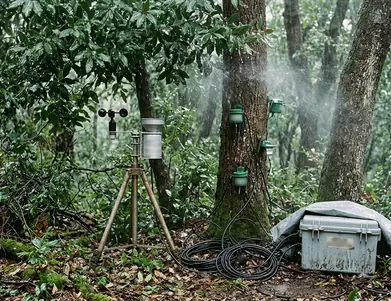
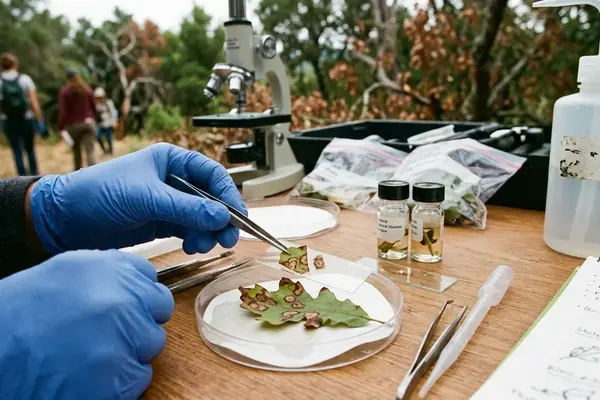
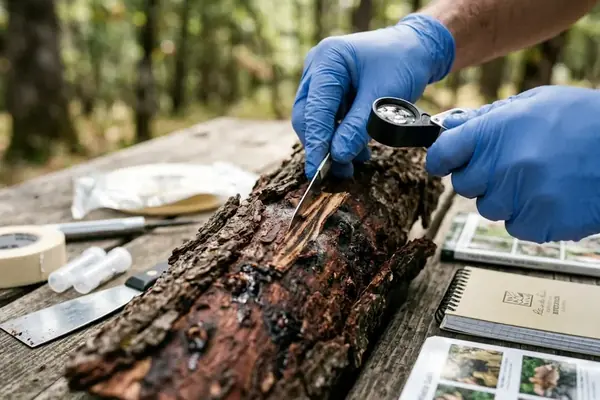
Spring is when sod blitz surveys and other citizen-science efforts collect most of their useful data, because active lesions are fresh and the pathogen cultures well. The typical window runs from mid-April through late May. Collectors gather 5 to 10 symptomatic bay laurel leaves per tree, choosing leaves with dark, water-soaked lesions along the drip tip.
Where on the tree a leaf comes from matters. Coordinators restrict sampling to the lower 2 meters of the bay laurel canopy because laboratory culturing showed that sun-exposed upper leaves gave high false-negative rates, even in wet springs.
Sample Low, Ship Fast
Double-bag leaves in dry paper envelopes inside sealed plastic bags, and get them to a diagnostic lab within 48 to 72 hours of picking. Leaves held longer let secondary saprophytic fungi overgrow the culture plate and mask the result.
Laboratory confirmation is required. Several native leaf spots produce dark tip lesions that look very much like P. ramorum damage, and visual diagnosis alone will mislabel some trees in both directions.
July to September: Dry Canopy, Dormant Pathogen, Open Work Window
Late summer is the lowest-risk period of the year for human-assisted spread, and it is the window for pruning, selective bay laurel removal around high-value oaks, and timber or fuel-reduction work.
The reason is biological. Active foliar sporulation stops once daytime temperatures regularly exceed 30°C (86°F) for 5 to 7 consecutive days. The pathogen then survives in two refuges: inside the inner bark cankers of oaks it has already infected, and as dormant chlamydospores in scorched bay laurel leaf tips and the upper 5 centimeters of forest soil. In that state it cannot release swimming spores, and fresh pruning wounds on oaks are rarely colonized while relative humidity stays low and bay leaf lesions are dry. Arborists and preserve managers have consolidated bay-to-oak clearance cutting into August and September for this reason.
Clearance targets
- Wait at least 30 days after the last measurable late-spring rain before starting major thinning or chipping in infested stands.
- Identify high-value coast live oak, California black oak, and canyon live oak trees.
- Remove all California bay laurel foliage within a 2.5-to-5-meter (8-to-16-foot) radius of those trunks.
- Clean dry dust and soil from tools, boots, and tires before moving to the next site.
Reading summer symptoms correctly
Late summer is also when many landowners first notice trouble: oaks bleeding dark reddish-black sap, or crowns turning brown within a few weeks. Those trees were infected during earlier wet springs. Removing dead wood in dry weather carries minimal transmission risk, provided crews clean dry soil and dust from tools and boots. Bleeding in August calls for planning next season's protection of the surrounding trees, since the tree itself was infected long before.
October to November: Phosphonate Timing and a Property Walk
The first significant autumn storms restart the cycle. Early rain totals of 25 to 38 millimeters (1 to 1.5 inches) are enough to re-wet forest litter and reactivate dormant chlamydospores on surviving evergreen bay leaves. Cool winter temperatures have not yet set in, so the pathogen gets a head start before the slow winter build-up begins.
Spring versus autumn applications
Preventative chemical treatment illustrates why timing matters more than product choice. Phosphonate applied in early spring meets the infection peak with limited time for the tree to move the compound into living bark. Applied in October and November, the same treatment rides on several weeks of active autumn transpiration, which carries it into the inner bark before winter rain releases the first wave of inoculum. Applicators moved their schedules to autumn after phloem-mobility trials showed that difference.
Two delivery methods are in common use:
- Basal bark spray: phosphonate mixed with an organosilicone surfactant, applied from ground level up to 1.5 meters (5 feet) on the trunk.
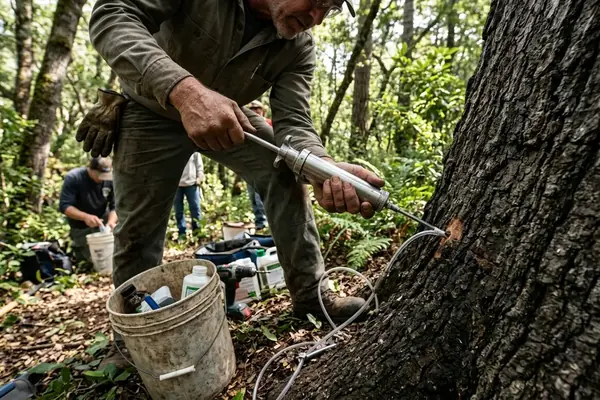
- Pressurized trunk injection: delivered directly into the conductive tissue.
Both need 4 to 6 weeks before heavy winter rains for full phloem uptake. Count backward from your area's typical onset of sustained rain, and book the applicator accordingly. The October and November dates in this guide come from California's dry-summer pattern and shift wherever autumn storms arrive early.
Protection, Not Rescue
Phosphonate treatment is preventative. It is meant for high-value oaks that are still uninfected. An oak already girdled by cankers will not recover from treatment, and budget spent there is better directed to its healthy neighbors.
Further detail on product labeling and application rates is available in the UC Statewide Integrated Pest Management Program guidelines on Sudden Oak Death.
Walk your property this week
Every window in this calendar depends on knowing where your bay laurels sit relative to your oaks, and that map takes a single afternoon to make. Take a tape measure and a roll of high-visibility flagging tape out today. At each healthy coast live oak, black oak, or tanoak, measure a 5-yard (4.5-meter) zone around the main trunk. Flag every California bay laurel stem whose canopy hangs inside that zone, and write on the tape whether that bay is slated for leaf sampling in mid-April or for clearance pruning once next August's dry spell has held for 30 days.


Your Thoughts
No comments.
Leave a Comment