
Contents
- Eight Years Under the Canopy at Pepperwood Preserve: What Worked and What Failed
- Why Staff Chose Targeted Stand Triage Over Preserve-Wide Eradication
- Cutting the Spore Bridge: Bay Removal Protocols and Understory Burn Windows
- Labor Hours, Slash Disposal, and the True Cost of Managing Bay Resprouts
- Eight-Year Monitoring Plot Results: Treated Groves vs. Untreated Control Draws
- Four Missteps Staff Would Correct If Starting Over Today
- How to Map and Prioritize Your Own Oak Stands Before Starting a Chainsaw
Eight Years Under the Canopy at Pepperwood Preserve: What Worked and What Failed
Stand on the upper ridge of Pepperwood Preserve in the Mayacamas Mountains and look in two directions. Overhead, a mature coast live oak (Quercus agrifolia) holds a full, dark-green crown. Its bark is clean. Turn toward the untreated draw a short walk downslope and the picture changes: thinning crowns, grey skeletal limbs, and trunks streaked with the reddish-brown seep that every oak steward in Sonoma County learns to dread.
That line between the two stands is the visible edge of an eight-year experiment in disease ecology.
The verdict, stated plainly: targeted removal of California bay laurel (Umbellularia californica) around priority oaks, paired with low-intensity prescribed fire in the understory, buffered high-value coast live oak stands from the heaviest Phytophthora ramorum spore loads. Treated groves held their canopy through a window that included two severe multi-year drought cycles and two atmospheric river winters. Control draws did not fare as well.
The operational realities matter as much as the result. Eradicating the pathogen across a roughly 3,100-acre preserve was never on the table, financially or ecologically. Staff had to triage, choosing a limited set of stands to defend. They had to budget for years of bay resprout control after the first cut. And they had to widen their original clearing boundaries once field observations showed the initial radius was too narrow. Each of those points shapes how any land trust should approach disease management and prevention on its own ground.
Why Staff Chose Targeted Stand Triage Over Preserve-Wide Eradication
The dieback wave that forced a decision
Symptoms spread across the preserve during the first multi-year wave of dieback. Century-old coast live oak canopies were at risk, and with them the acorn mast that feeds deer, woodpeckers, jays, and the small mammals that sit underneath the whole food web. Managers evaluated that wave and reached a sobering conclusion: chasing single symptomatic trees across steep canyons would exhaust stewardship budgets in two seasons. So they shifted strategy toward defending contiguous, high-canopy ridge groves.
Why bay laurel drives the epidemic and oaks absorb the damage
The pathology explains the choice. California bay laurel acts as the primary foliar host. Its leaves carry blotch infections that rarely kill the tree, and during spring rain those lesions produce sporangia in large numbers. In inland Sonoma County, sporulation peaks when ambient temperatures stay between 60°F and 68°F during multi-day rain events. Rain splash and wind carry that inoculum onto nearby oak bark.
Coast live oaks sit at the other end of the chain. They are terminal, or "dead-end," hosts: the pathogen invades the bole, forms bleeding cankers, and girdles the tree, yet oaks contribute little to onward spread. Removing a dying oak does almost nothing for its neighbors. Removing the bay foliage that showers spores onto healthy oaks addresses the source.
Turning monitoring plots into a protection map
Stewardship staff cross-referenced long-term vegetation monitoring plots, established across an elevation gradient from 800 to 1,800 feet, against topographic moisture indices. The goal was specific: find stands where mature coast live oaks shared canopy space with dense bay laurel recruitment. Moist, shaded positions with heavy bay presence ranked as high exposure. Infection density already recorded in the plots added a third layer.
From there the selection narrowed to accessible uplands and high-value wildlife corridors. Groves that crews could reach with equipment, that held large oaks, and that connected habitat across the preserve rose to the top. Remote canyon bottoms with scattered oaks and heavy existing infection dropped off the list. Spreading the same labor thinly across the whole property would have protected nothing well.
Cutting the Spore Bridge: Bay Removal Protocols and Understory Burn Windows
Thinning around priority oak trunks
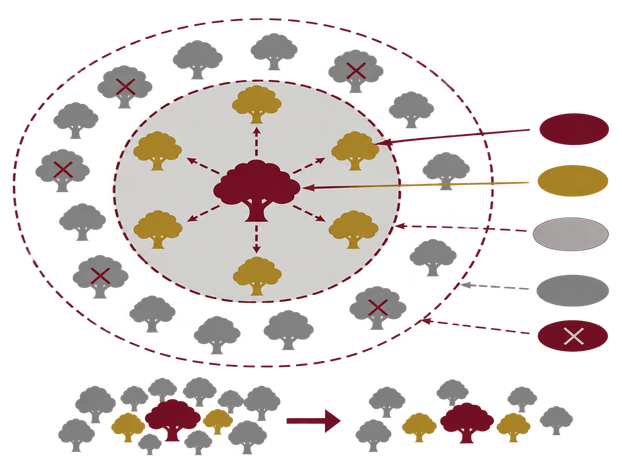
The final thinning protocol is tiered by slope position. Around each priority coast live oak bole, crews establish a bay-free buffer radius of 16 to 33 feet (5 to 10 meters). On windward upslope aspects, where storm-driven rain pushes droplets downslope and across open ground, that buffer expands to as much as 50 feet. Why the protocol settled on these widths is covered in the missteps section below.
Within each oak's drip line, crews remove every understory bay laurel stem under 6 inches diameter at breast height (DBH). Larger bays inside or bordering the buffer get pruned so that no bay branch overtops or brushes against oak bark. The physical contact point matters: a bay limb resting against an oak trunk delivers inoculum directly, with no wind required.
- Flag the priority oak and mark the buffer radius appropriate to its slope position.
- Fell all bay stems under 6 inches DBH inside the drip line.
- Prune low or overhanging bay branches on remaining larger trees so foliage no longer touches or hangs above oak bark.
- Record stump locations so follow-up crews can find and treat resprouts.
Timing low-intensity understory burns
Prescribed fire did three jobs in the treated stands. It consumed infected bay leaf litter on the forest floor, suppressed the prolific basal resprouting that bay stumps produce, and thinned dense understory fuels. Crews conducted broadcast understory burns during late-autumn and winter prescription windows, holding flame lengths under 2 to 3 feet. At that intensity, fire moves through litter and low shrubs without scorching oak cambium.
The litter effect deserves attention. Tagged-tree and soil records from the preserve indicate that the heat pulse through soil and litter during these low-intensity burns reduces surface inoculum recovery for 12 to 16 months post-fire. That gives a treated grove at least one spring rain season with a cleaner forest floor.
Sanitation and slash handling
Cut bay slash stays on site. Crews pile it locally and burn it during safe winter windows, which keeps infected leaves off the preserve's clean roads and out of truck beds headed to uninfected areas. Burn piles sit at least 25 feet from mature oak feeder root zones and canopy drip lines, a setback that protects both cambium and the mycorrhizal networks oaks depend on. Dense bay slash needs a minimum 6-to-9-month curing period before winter ignition, so piles built during one winter's cutting typically burn the following winter.
Keep Infected Slash Local
Hauling bay brush to a green-waste yard or another property moves live inoculum across the landscape. Pile and burn inside the treated unit, and clean tools and boots before leaving an infested stand.
Labor Hours, Slash Disposal, and the True Cost of Managing Bay Resprouts
Most first-time project budgets for SOD thinning are front-loaded. They price the chainsaw work, maybe the slash piling, and stop there. Pepperwood's experience shows why that framing underestimates the commitment by a wide margin.
What a felling day actually buys
A 3-to-4-person chainsaw crew clears roughly 0.5 to 1.25 acres per day in dense, sloped bay-oak draws. The spread depends heavily on how far crews must carry slash to a piling site. On a gentle bench with an opening nearby, output sits near the top of that range. In a steep draw where every armload goes uphill, it drops toward the bottom.
That first pass is only the opening move.
Bay laurel's biological persistence
California bay laurel resprouts vigorously from cut stumps. Basal resprouts on untreated stumps grow 3 to 5 feet within 14 to 18 months of winter cutting. Those sprouts carry tender, highly susceptible foliage, and by the second spring they can rebuild the very spore bridge the felling was meant to break. A stump left alone becomes a low, dense bay shrub sitting inside the oak's protective buffer.
Follow-up options include repeated hand brushing, targeted stump treatment, and repeated prescribed fire. Each has labor and scheduling costs that recur year after year. After comparing sawyer crew daily acreage against these brushing demands, land managers restructured multi-year budgets around a firm rule: initial felling in a unit is never approved unless three subsequent seasons of stump-sprout suppression are scheduled for the same unit.
Budget the Fourth Year First
Before approving any bay removal, confirm funding and crew time for three seasons of resprout control on that same ground. If the follow-up isn't secured, postpone the cut.
Mechanical thinning versus broadcast burning
The two tools suit different terrain. In dense, steep draws, mechanical thinning is the only practical way to remove bay stems selectively around individual oaks; fire alone cannot discriminate between a bay sapling and an oak seedling in heavy fuel, and dense draws carry more risk of intense burning. The cost per acre is high because crew output is low.
Across broader, contiguous oak savannas with lighter understory, broadcast prescribed burning covers far more ground per crew-day. It handles litter inoculum and suppresses low resprouts across the whole unit at once. Its limits are the prescription window itself and the need for trained burn personnel. A sensible program uses saws to establish buffers in the draws and fire to maintain the open savanna and previously thinned units.
| Stand Condition & Aspect | Existing Oak Canker Incidence | Recommended Labor Priority | Buffer and Treatment Notes | |
|---|---|---|---|---|
| High-vigor oaks, sheltered or downslope position | Few or no bleeding cankers | Highest | 16–33 ft bay-free radius; remove bay stems under 6 in DBH within drip line | |
| High-vigor oaks, windward upslope aspect | Few or no bleeding cankers | Highest | Expand buffer toward 33–50 ft on the upslope side | |
| Contiguous open savanna with light bay understory | Low | Moderate | Broadcast burns in late-autumn/winter windows, flame lengths under 2–3 ft | |
| Steep, shaded draw with dense bay recruitment | Widespread existing bole cankers | Low | Defer intensive thinning; monitor; prioritize healthier stands first |
Eight-Year Monitoring Plot Results: Treated Groves vs. Untreated Control Draws
Baseline conditions before treatment
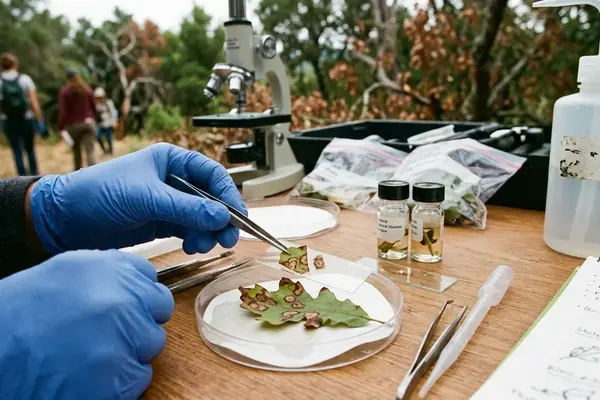
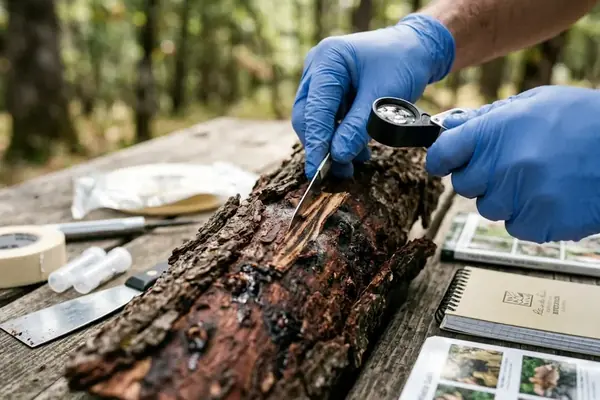
Before any cutting, priority groves and control draws looked broadly similar: mature coast live oaks with bay laurel crowding the mid-story and understory, and a scattering of symptomatic trees. Researchers tagged individual coast live oaks in both treated and unthinned control draws and checked them every spring.
Reading the first two years correctly
Early results could have been discouraging. Some oaks in freshly cleared buffers developed bleeding cankers within the first 18 months. The tagging records let researchers separate those trees from the rest. The monitoring points to an 18-to-24-month latency window during which coast live oaks already infected before clearing still develop bleeding exudate, regardless of the bay removal around them. Those trees were carrying the pathogen before the saws arrived.
Separating latent infections from new ones made the real signal visible. Oaks that stayed symptom-free through the latency window and then through subsequent wet winters were the measure of whether the buffers worked.
Outcomes after eight years
Across the eight-year window, treated groves retained their canopy more consistently than the control draws, and new bleeding canker incidence among oaks that cleared the latency period stayed lower inside thinned and burned plots. The control draws continued to accumulate symptomatic trees and crown dieback.
Weather tested both conditions hard. During wet spring sporulation events, particularly the atmospheric river winters, the thinned buffer zones held up where they had been sized to slope position. The drought cycles brought a different stress: oaks weakened by prolonged water deficit showed reduced vigor in both treated and control areas, and treatment could not offset that physiological strain entirely. Buffers reduce exposure. They do not water a tree.
A note on transferability belongs here. These thinning thresholds reflect inland Sonoma County mixed-hardwood ridges, where summer heat naturally suppresses mid-year sporulation. A seasonally dry ridge gives a cleared buffer months of rest each year, and that rest is part of why the method works on these slopes.
Secondary ecological gains
Opening the canopy and burning the understory produced benefits nobody had built the project around. Monitoring plots in treated units recorded increased native grass and forb diversity following canopy opening and understory burning. More light reached the ground, the bay litter layer thinned, and herbaceous species that had been shaded out returned. For a woodland conservation program, that shift toward a more open, oak-woodland structure carries habitat value of its own.
Four Missteps Staff Would Correct If Starting Over Today
Field crews and stewardship staff describe these lessons in practical terms, the kind you learn on a slope in the rain. Each one changed a written protocol.
Misstep 1: Underestimating buffer widths on windward ridges
During the first winter, crews cut a standard 8-foot clearance around high-value oak trunks. Spring rain-splash monitoring then showed wind-blown droplets bridging that gap. On windward Mayacamas ridges, storm-driven rain carried P. ramorum sporangia from upslope bay crowns across the cleared ring and onto oak bark. Staff dropped the narrow radius and adopted the tiered buffer by slope position, with 33-to-50-foot clearances on the upslope side of exposed oaks.
Misstep 2: Waiting too long on basal sprouts
Delays between the initial cut and secondary maintenance let bay sprouts flush with tender, highly susceptible foliage right at peak spring rain. A stump that would have been easy to brush in its first growing season became a sporulating shrub inside the buffer. The three-season suppression rule described earlier grew directly from this.
Misstep 3: Intervening too late in heavily symptomatic groves
Early labor went into some stands that already had widespread bole cankers. Survival there was poor, which fits the latency data: many of those oaks were infected before treatment began. Labor spent preemptively on minimally infected, high-vigor stands produced far better results.
Misstep 4: Building slash piles in shaded creek draws
Post-burn inspections in year three found that bay slash piles built inside shaded creek draws retained too much core moisture to ignite cleanly during brief winter burn windows. Half-burned piles left infected material in place. The permanent fix: crews now haul slash to sunny mid-slope openings at the time of cutting, where piles cure through the 6-to-9-month minimum and still respect the 25-foot setback from oak root zones and drip lines.
Fog Belt Changes the Math
Do not copy these buffer widths into coastal tanoak-redwood canyons. Summer fog drip there keeps aerial dispersal going year-round, and canopy-to-canopy tanoak sporulation bypasses localized bay clearing.
How to Map and Prioritize Your Own Oak Stands Before Starting a Chainsaw
Preserve educators condensed the triage protocol into a single spring walk-through so that adjacent private landowners and smaller land trusts could avoid overspending on dead-end tree work. It belongs before any arborist bid, not after.
- Walk the parcel between April and June. Foliar blotches on bay laurel leaves and dark reddish-brown bleeding on oak bark are most visible in this window.
- Flag high-value asymptomatic coast live oaks. Large, vigorous trees with clean bark and full crowns are your priority. Note symptomatic oaks separately; they rank lower.
- Measure the distance from each flagged oak to the nearest overhanging bay foliage. Record slope position too, since windward upslope bays need the wider buffer.
- Size each bay near a priority oak. Field crews typically use an 8-inch DBH threshold to decide between complete bay felling and high-crown pruning with basal thinning.
- Map sunny openings for slash piles at least 25 feet from oak root zones before any cutting starts.
If your parcel also participates in sod blitz surveys, those spring results can confirm whether bay infections are present nearby, which sharpens which oaks to defend first.


Your Thoughts
No comments.
Leave a Comment