
The Case for Mixed-Canopy Succession
The most effective way to honor a fallen oak is not to plant another oak in its exact footprint, but to engineer a mixed-canopy succession that actively resists future pathogen waves. Replanting single, susceptible oak species in cleared areas perpetuates the disease cycle. Establishing diverse, non-host native plant communities breaks it.
Early restoration efforts attempted to replant coast live oaks directly in cleared gaps, assuming the removal of infected biomass was sufficient to protect the new generation. Field assessments tracking these initial sites documented residual soil inoculum infecting new susceptible saplings within 18 to 24 months of planting. The rapid reinfection of these young trees demonstrated that clearing above-ground biomass does little to eliminate the microscopic threat lurking below. This realization shifted the restoration focus entirely to non-host native plant communities.
The core strategy for woodland conservation now requires moving away from species-specific restoration toward holistic woodland resilience, prioritizing the long-term survival of the ecosystem over the replication of its past composition.
The Hidden Cost of Single-Species Restoration
Landowners and preservationists naturally feel an emotional drive to restore exactly what was lost to Phytophthora ramorum. Seeing a massive canopy gap creates an immediate urge to fill it with the same iconic species that defined the woodland for decades.
Pathogen Persistence Reality: Replanting coast live oak saplings directly into the root zone of a recently removed infected tree leads to rapid sapling mortality from residual soil inoculum.
Soil sampling from affected woodlands reveals lingering pathogen loads concentrated in the upper 15 to 30 centimeters of soil. Introducing a new susceptible host into this environment guarantees continuous disease transmission, effectively feeding the pathogen and maintaining its presence in the local ecosystem.
Monoculture replanting ignores compounding environmental stressors that dictate sapling survival. Localized dry periods extending from late May through October weaken young oaks, making them highly vulnerable to these lingering pathogen loads. Foresters evaluating replanting sites have consequently shifted their assessment protocols from above-ground canopy aesthetics to prioritizing soil moisture retention and localized drought stress indicators. Recognizing that a stressed sapling is a susceptible sapling, these updated protocols ensure that restoration efforts account for the harsh realities of the changing climate and the persistent nature of the disease.
Designing for Climate and Pathogen Resilience
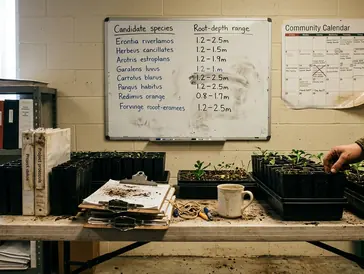
Filling the canopy gaps left by SOD mortality requires introducing non-host or highly resistant native species. When designing resilient canopies, restoration planners prioritize species with varied root depths—ranging from about 1.2 to 2.5 meters—to stabilize soil without competing directly in the same strata. This underground architecture prevents erosion in the newly opened gaps while ensuring that each plant has access to distinct water resources.
Above ground, this structural diversity, combined with varied canopy heights, disrupts the wind-driven rain splash mechanisms that spread water molds. By creating physical barriers and altering airflow, a mixed canopy reduces the distance spores can travel during storm events. A strict rule applies to these designs: excluding California bay laurel from all new planting layouts due to its high sporulation rate.
While mixed-canopy planting effectively suppresses pathogen spread in coastal microclimates, its long-term viability depends heavily on local soil drainage profiles and the presence of summer fog drip to sustain the non-host understory. The selection of non-host broadleaf species must be adjusted based on the specific summer fog drip accumulation of the local microclimate. A species that thrives in a heavy fog zone may fail entirely in a drier, inland-facing gap just a few miles away.
A Step-by-Step Blueprint for a Cleared SOD Patch
Consider a standard 50-foot canopy gap left by a removed oak. The blueprint for this cleared patch relies on mapping micro-humidity zones within the gap to maximize airflow and minimize the leaf wetness duration critical for disease ecology.
Step 1: Site Preparation and Soil Rest
Manage the immediate aftermath of tree removal without disturbing the soil excessively. Heavy machinery and aggressive tilling can spread the pathogen further into the surrounding healthy woodland. Implement a mandatory soil rest period of 6 to 9 months post-removal to allow surface inoculum levels to degrade. During this resting phase, the site remains unplanted, allowing natural solarization and seasonal drying to reduce the viability of the water molds in the upper soil layers.
Step 2: Selecting and Spacing the Native Mix
Integrate a three-species mix tailored to the site: a non-susceptible conifer like Douglas-fir, a resistant understory shrub such as Toyon, and a broadleaf non-host like Bigleaf maple. Space these saplings at 4.5 to 6-meter intervals. This specific spacing ensures adequate airflow and reduces micro-humidity, establishing a resilient woodland architecture that actively defends against future outbreaks. The Douglas-fir provides rapid vertical growth to shade the forest floor, the Toyon offers mid-level structure and wildlife value, and the Bigleaf maple contributes broad canopy cover without serving as a host for the pathogen.

Your Thoughts
No comments.
Leave a Comment