
Why Strategic Snag Retention Outperforms Wholesale Clearing
When Sudden Oak Death moves through a landscape, the visual impact of rapidly browning canopies often prompts an immediate, aggressive response. Initial post-mortality strategies often defaulted to wholesale clearing of dead stands to mitigate perceived risks. Property owners and land managers frequently deployed heavy equipment, such as tracked excavators and feller bunchers, to remove every affected tree in an attempt to sanitize the woodland. Ecological monitoring later confirmed that this intensive intervention caused secondary damage that severely compromised the surviving canopy.
Land managers shifted toward strategic retention after observing that the heavy machinery required for clear-cutting caused severe soil compaction. This compaction actively damaged the fine feeder roots of adjacent, surviving oaks and accelerated their decline. The mechanics of this secondary damage are rooted in the physical properties of woodland soils. Soil compaction from heavy machinery during wholesale removal operations can extend up to 24 inches deep into the soil profile. Because the vast majority of an oak's fine feeder roots reside in the top 12 inches of soil, this deep compression eliminates the macropores necessary for oxygen exchange and water infiltration, effectively suffocating the root systems of the very trees the clearing operations intended to protect.
Strategic retention of standing dead wood provides a superior management approach that prioritizes the long-term health of the entire woodland ecosystem. Landowners only need to fell trees that threaten specific targets like structures or roads. Leaving remote dead trees as wildlife snags provides critical habitat and reduces unnecessary soil disturbance. Field surveys demonstrate that retaining standing dead wood provides critical foraging and nesting habitat for over 40 species of cavity-nesting birds and small mammals in coastal oak woodland ecosystems. By leaving these snags in place, the woodland retains its structural complexity and nutrient cycling capacity.
Effective post-mortality management relies on three core pillars:
- Rigorous hazard assessment to determine which trees pose a physical threat to infrastructure.
- Precise timing of removal operations to minimize the risk of spreading the pathogen.
- Meticulous on-site wood processing to ensure felled biomass degrades safely.
Differentiating Immediate Structural Threats from Ecological Assets
A dead tree only becomes a hazard when it has a specific target to strike. In the context of woodland management, targets include homes, powerlines, high-traffic trails, and primary driveways. A towering dead oak located deep in an inaccessible ravine poses zero threat to human infrastructure and functions entirely as an ecological asset. The primary task for any property owner is evaluating the spatial relationship between declining trees and valuable infrastructure.
Understanding the structural degradation timeline of different species is crucial for prioritizing removal efforts. Tanoaks and coast live oaks respond to Phytophthora ramorum infection with vastly different mechanical failure patterns. Tanoaks typically exhibit structural failure at the root crown or lower trunk within 2 to 4 years post-mortality. The rapid decay of tanoak sapwood, often accelerated by secondary colonizers like ambrosia beetles and decay fungi, means these trees frequently collapse at the base long before their upper canopy branches begin to shed. A dead tanoak within striking distance of a target requires prompt attention.
True oaks demonstrate significant structural resilience even after complete canopy mortality. Coast live oaks possess denser wood and often remain standing as stable, ecologically valuable snags for 7 to 12 years before major limb drop occurs. The dense heartwood of a coast live oak resists fungal decay much longer than tanoak tissue—allowing property owners to monitor these trees over multiple seasons rather than rushing to fell them immediately.
Slope Evaluation Limits Visual assessments of leaning trees are insufficient for primary residences built on slopes exceeding a 15-degree grade, where complex root plate lifting requires evaluation by a Tree Risk Assessment Qualified (TRAQ) arborist.
This limitation highlights the complexity of evaluating potential hazards on steep terrain. The gravitational forces acting on a decaying root system introduce variables that standard distance measurements cannot capture. Engaging a certified professional ensures that complex structural threats receive the rigorous analytical scrutiny required to protect high-value targets.
Scheduling Felling Operations to Suppress Pathogen Dispersal
The seasonal lifecycle of Phytophthora ramorum dictates the operational calendar for any woodland management activity. This pathogen thrives in cool, wet environments, relying on splashing rain and saturated soils to produce and disperse its microscopic spores. Understanding this biological rhythm allows property owners to schedule interventions that actively suppress disease transmission.
Early management protocols attempted to fell trees immediately upon mortality detection in late winter to eliminate the hazard quickly. This approach was abandoned after field observations confirmed that operating chainsaws and skid steers in wet, muddy conditions actively tracked Phytophthora ramorum spores into previously uninfected stands. The deep treads of heavy machinery and the boots of cutting crews easily transport infested mud across property lines, establishing new disease epicenters miles away from the original infection site.
To mitigate this vector, land managers must adhere to a strict seasonal schedule. Restrict felling, limbing, and heavy equipment operations to the dry season window, typically between mid-August and late October. During this late summer to early fall window, ambient soil moisture drops below the threshold required for Phytophthora ramorum sporangia production. The pathogen enters a dormant state, drastically reducing the likelihood of viable spores adhering to equipment or being aerosolized by wood chippers.
Executing removal operations during the optimal dry season provides a critical secondary benefit for the broader ecosystem. Dry soils possess significantly higher load-bearing capacity than saturated winter soils. Operating heavy machinery when the ground is firm minimizes soil compaction and lowers the risk of crushing the delicate root zones of adjacent, surviving trees. This careful timing protects the subterranean architecture of the woodland while neutralizing the above-ground structural hazards.
Processing and Solarizing Infected Biomass On-Site
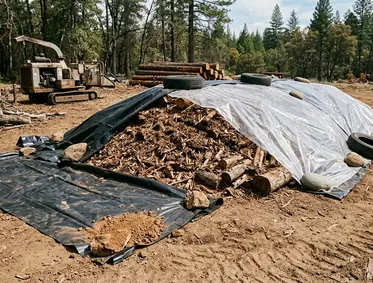
Once a hazard tree is safely on the ground, the management focus shifts to processing the infectious biomass. The most critical risk during this phase involves the transportation of unseasoned wood. Moving infected logs across county lines establishes new disease epicenters, introducing the pathogen to vulnerable, previously isolated oak populations. Compliance with federal quarantine laws is mandatory, and the most effective way to adhere to these regulations is to process and retain all felled material directly on the property where it originated.
On-site management requires specific techniques to neutralize the pathogen rapidly. For smaller branches and canopy debris, mechanical chipping accelerates the drying process. Broadcast chipped slash in a layer no thicker than 2 to 3 inches to ensure rapid desiccation and reduce pathogen viability. If the mulch layer exceeds this depth, the lower levels retain moisture, creating a dark, damp microclimate that allows Phytophthora ramorum to survive and potentially sporulate. A thin, evenly distributed layer exposes the maximum surface area to ambient air and sunlight.
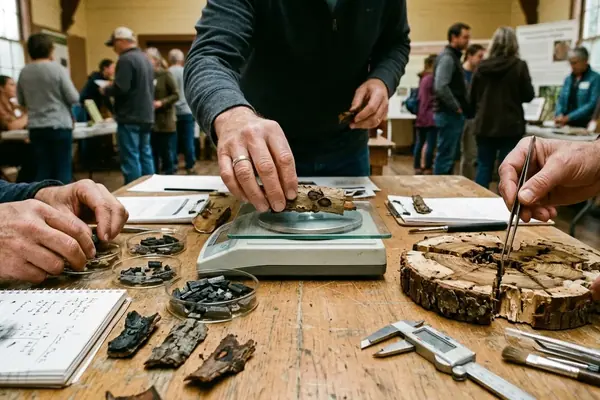
Handling the main trunk and larger structural limbs requires a different approach, as these massive pieces of wood retain internal moisture for extended periods. Cut, split, and stack the larger logs on-site in a location that receives abundant direct sunlight. Splitting the wood is a vital step; intact bark acts as a moisture barrier, while exposing the inner heartwood to the air accelerates evaporation. To actively destroy the pathogen, implement a proven solarization technique.
Biomass Solarization Protocol Solarization of larger logs requires covering stacked wood with clear, 6-mil polyethylene sheeting in a location receiving at least 6 hours of direct sunlight daily for a minimum of 6 months.
Clear plastic is essential for this process. It allows short-wave solar radiation to penetrate and heat the wood, while trapping the long-wave thermal radiation inside, creating a greenhouse effect. Black plastic merely absorbs the heat on its surface and fails to generate the internal temperatures necessary to pasteurize the stacked timber.
Delineating Strike Zones Prior to Equipment Deployment
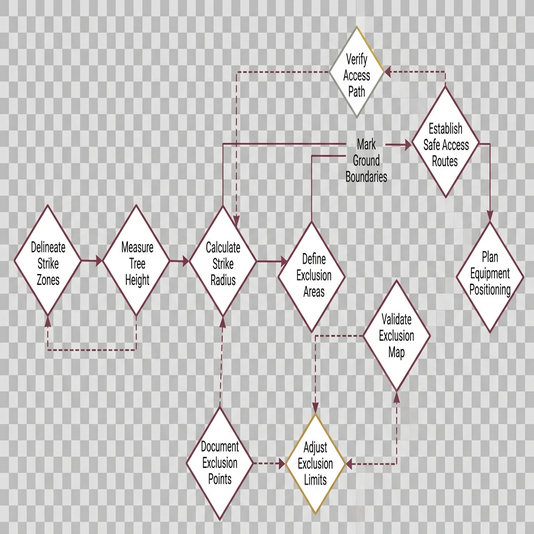
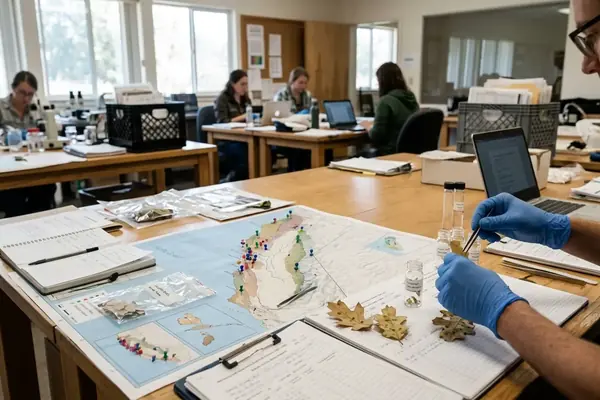
The transition from theoretical planning to physical execution requires precise spatial mapping. Before engaging contractors or starting any equipment, property owners must translate the principles of hazard assessment into a tangible site plan. Do not hire a crew or start cutting until you have physically mapped your property's target zones. This preparatory step prevents unnecessary ecological damage and ensures that financial resources are directed only toward genuine structural threats.
The foundation of this mapping process is the calculation of the potential impact area for each declining tree. Establish a strike zone radius of 1.5 times the total height of the dead tree. This multiplier accounts for the unpredictable dynamics of a falling trunk, including the potential for the tree to slide, bounce, or shatter upon impact, sending heavy debris far beyond the immediate footprint of the canopy.
Applying this formula provides clear, objective boundaries for removal operations. For a 60-foot dead tanoak, this requires mapping a 90-foot clearance radius around structures, driveways, and utility lines to determine if it qualifies as a hazard. If the tree stands 100 feet away from the nearest target, it falls outside the strike zone and should be retained as a wildlife snag.
Estimate the total height of the dead oak from root crown to highest branch tip. Multiply the estimated height by 1.5 to determine the potential strike radius. Walk the calculated radius with a notepad to identify and mark only the dead trees falling within these specific boundaries, leaving the rest of the woodland undisturbed.




Your Thoughts
No comments.
Leave a Comment