
A dozen neighbors with pruners and enthusiasm can produce a beautiful map of nothing. The difference between a weekend walk in the woods and a dataset a diagnostic lab will actually process comes down to decisions made months before anyone clips a single bay laurel leaf.
Contents
- What a Rigorous Neighborhood Survey Actually Demands
- Working Backward From the Last Spring Rain
- One Hour, Two Hosts, and a Hundred Look-Alikes
- Envelopes, Coolers, and Coordinates
- When the PCR Results Land, Cut the Right Bay Laurels
What a Rigorous Neighborhood Survey Actually Demands
What does it take to turn a group of concerned residents into a forest disease monitoring team whose data survives scientific scrutiny?
Three things. Secured diagnostic lab capacity. Standardized volunteer training. Uncompromising sample preservation protocols. Every SOD Blitz that produced usable maps was built on those three pillars, and every one that collapsed into a pile of unusable leaves was missing at least one of them.
Enthusiasm has never been the bottleneck in woodland conservation. Early community efforts leaned hard on that enthusiasm and ran continuous, month-long sampling windows so that anyone could participate whenever their schedule allowed. It felt generous. It was also unworkable: diagnostic labs reported that staggered, unpredictable sample arrivals wrecked their batch PCR testing schedules, forcing technicians to run partial plates or hold degrading material. Organizers abandoned the open window and replaced it with a tightly controlled collection period of 48 hours maximum, timed so the lab knows exactly when the flood arrives and can clear bench space for it.
That single change reframes the entire planning process. The survey is a logistics operation with a botanical component, and the logistics run on the lab's calendar, not the community's.
Before You Announce
Do not publicize a date, print a flyer, or open a signup form until a lab has confirmed in writing how many samples it will accept and on which days. Public announcements create obligations that lab capacity may not honor.
Working Backward From the Last Spring Rain
The Backward Planning Sequence
The pathogen sets the schedule. Phytophthora ramorum sporulates in wet conditions, and the leaf lesions that volunteers are trained to spot need time to develop into something legible on a California bay laurel leaf. Sample too early and the lesions are invisible. Sample too late and summer drought has curled and browned everything into ambiguity.
Successful organizers solved this by tracking local rainfall rather than the calendar, scheduling the blitz six to eight weeks after the final significant spring rain event. In a wet year that pushes the weekend later; in a dry year it pulls it forward. The date is set by weather station data, then locked.
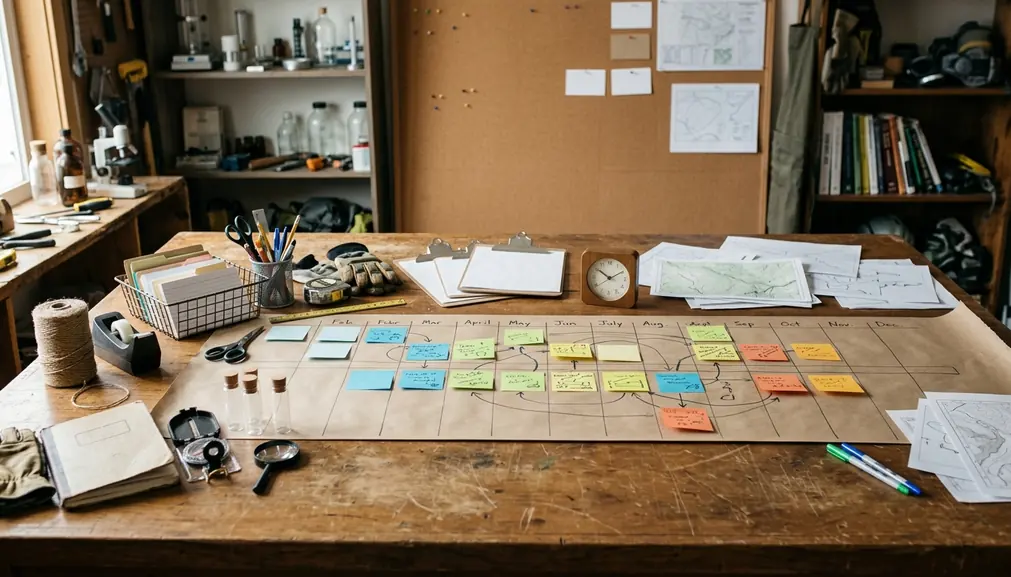
- Five months out: approach a certified diagnostic laboratory or university extension program. Confirm they run Phytophthora PCR assays, confirm they will accept community-collected material, and confirm a specific processing window. Partnerships secured four to five months prior give the lab time to budget reagents and staff hours.
- Four months out: negotiate the sample cap. Standard university extension batch processing limits put most local blitzes at 200 to 300 samples. That number is not a suggestion. It is the hard ceiling on everything downstream.
- Three months out: divide the cap into per-volunteer allocations. If the lab takes 240 samples and each trained volunteer collects six, the survey supports 40 people. Recruitment targets follow from arithmetic, not from ambition.
- Two months out: draw the survey grid. Geographic scope is a function of the same cap. Spreading 240 samples across an entire county produces a map too sparse to guide any management decision; concentrating them in three watersheds produces a map that does.
- Six weeks out: open registration, with the rainfall-derived date now fixed.
Organizers who reverse this order end up with around 90 registered volunteers, a 200-sample cap, and a very awkward email to write.
One Hour, Two Hosts, and a Hundred Look-Alikes
Recruitment yields vary sharply by landscape. Land trusts deliver reliable, already-trained naturalists. Homeowner associations in the wildland-urban interface produce excellent turnout because they have a mailing list, a meeting schedule, and residents whose oaks are visible from their kitchen windows. That same strategy falls flat in heavily forested, unincorporated regions where no centralized communication channel exists and outreach has to happen one fire-safe council meeting at a time.
Established naturalist groups — birders, native plant society chapters, trail stewardship crews, are the highest-value target of all. They already know how to read a plant, and they already own boots.
What Goes Into the Mandatory Hour
Training runs one hour, it is mandatory, and no one collects without it. The curriculum centers on the primary carrier hosts: California bay laurel and tanoak. Volunteers learn to recognize the characteristic leaf spots and tip dieback, the way lesions concentrate at leaf tips and along drip lines, and the difference between a foliar host that spreads inoculum and a canker host that dies from it.
Then comes the part that actually determines the survey's value.
When coordinators designed the curriculum, they weighted it heavily toward ruling out look-alikes rather than toward celebrating textbook positives. The reasoning was operational: diagnostic labs had been burning hours on harmless leaf spots caused by native fungi, insect feeding damage, sunscald, and simple mechanical abrasion. Every wasted assay is a real infection somewhere else that never got tested. Bay laurel leaf spot false-positive triage became the core skill, taught with paired photographs and, where possible, live branch samples of each confounding condition.
A volunteer who confidently walks past a fungal leaf spot has contributed more to the dataset than one who collects it.
Worth stating plainly during training: even well-taught field screening misses early lesions on bay laurel that have not yet expanded past the vein margins, so a negative walk-through is a weaker signal than a positive one.
Envelopes, Coolers, and Coordinates
Sample integrity is the pillar most often lost, and it is lost in car trunks.
Deployment starts Friday evening or Saturday morning with the distribution of identical collection packets. Standardization here is not aesthetic. It removes every opportunity for a volunteer to improvise a solution that degrades DNA.
Standardized Volunteer Collection Packet Contents
- Pre-labeled, breathable paper collection envelopes (never plastic)
- Rubbing alcohol wipes for sanitizing pruning clippers between trees
- Visual symptom ID card highlighting P. ramorum vs. common look-alikes
- Printed field instructions with the drop-off address, hours, and coordinator phone number
Plastic bags trap condensation, condensation feeds saprophytic mold, and mold overgrows the plate before the target pathogen can be detected. Paper breathes. The clipper wipes matter for the same reason a surgeon changes gloves: unsanitized blades move inoculum from an infected bay laurel to a clean one, and the survey then measures its own contamination.
Transport rules are equally rigid. Samples ride in coolers held at 4 to 10 degrees Celsius, and everything reaches the drop-off point within 24 hours of clipping. Warm leaves in a hot car for an afternoon are, for practical purposes, no longer samples.
Sample Killers
Heat, plastic, and delay. Any one of the three converts a valid collection into a lab rejection, and the volunteer who gathered it never finds out unless organizers tell them.
Coordinates Are Half the Data
A confirmed positive without a location is trivia. Planners standardized on a single mobile mapping application for all volunteers, retiring paper maps entirely, so that every sample is automatically tagged with precise latitude and longitude at the moment of collection and before the envelope is sealed. One app, one workflow, one training slide. Volunteers without smartphones are paired with someone who has one or issued a dedicated GPS unit.
Volunteers also need the scope stated bluntly: field identification is a screening tool. Visual symptoms alone confirm nothing. Only laboratory PCR testing distinguishes P. ramorum from its look-alikes, which is why the sample matters more than the volunteer's opinion of the sample. Organizers working across jurisdictional lines should also review the official Phytophthora ramorum guidelines before moving any plant material between counties.
When the PCR Results Land, Cut the Right Bay Laurels
Expect four to six weeks for PCR results. The lab returns a table of sample IDs with positive or negative calls; the organizer joins that table to the GPS coordinates and produces the map. Read it for pattern, not for individual points: clusters along drainages and north-facing slopes indicate established local inoculum, while isolated positives at the survey edge usually mean the infection front extends beyond the sampled area.
Here is where most community projects stop. A map gets posted, a newsletter goes out, everyone feels informed, and the tanoaks keep dying.
Effective programs structured the follow-up phase so that results immediately trigger mitigation. Confirmed positive bay laurels within a 10-meter clearance radius of high-value, uninfected oaks are prioritized for removal, because that foliar host is the inoculum factory feeding the canker infections that kill the oak. High-value oaks that cannot be protected by removal alone are candidates for phosphonate treatment, applied on the schedule their condition warrants.
Communication back to volunteers closes the loop and secures next year's turnout. Send each participant their own sample results alongside the aggregate map, name the specific trees their data helped protect, and publish the mitigation actions taken. People return to a survey that visibly changed something on the ground.
What Changes Monday
Treat the lab report as a work order. Positives inside the 10-meter radius of a healthy oak get scheduled for removal before the next wet season, not filed for discussion.
The recommendation is straightforward and organizers should commit to it before the first flyer goes out: budget for the chainsaw crew at the same time you budget for the envelopes. Data collection without a funded, pre-planned mitigation response is the most expensive way to watch a woodland decline. Line up the removal contractor during the same month you secure the lab, write the 10-meter protocol into the project plan, and let the PCR results tell that crew where to start.
Your Thoughts
No comments.
Leave a Comment