
Contents
- How Nursery Shipments and Boot Soil Spread Sudden Oak Death
- Where Phytophthora ramorum Survives: Bay Leaves, Bark and Mud
- Two-Stage Cleaning for Boots, Tires and Shears
- Screening Rhododendrons and Camellias Before They Go Near Oaks
- Keeping Prunings on the Parcel and Reading Quarantine Lines
How Nursery Shipments and Boot Soil Spread Sudden Oak Death
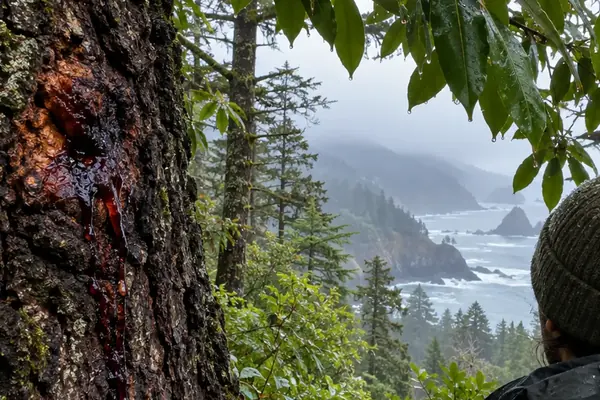
In the mid-1990s, tanoaks and coast live oaks began dying in scattered stands along the California coast. At first the mortality looked local: a cluster of bleeding trunks in one canyon, a band of brown tanoak crowns on one ridge.
Over the following two decades, the disease reached 15 coastal counties and crossed into southwestern Oregon. It travelled through two broad channels. Distinct pathogen lineages moved through the ornamental nursery trade, while others spread through wildland soil and foliage. Containment work in those years concentrated on the obvious suspect, large oak logs. Trace-back investigations then showed which pathways were actually linking separate watersheds: asymptomatic nursery stock and soil carried on hiking boots and service vehicles moved the pathogen far faster than timber transport.
That finding reshaped parcel-level biosecurity. Containment now rests on four habits a landowner, volunteer or forestry crew can apply directly:
- Dry-brush soil from boots and tires before leaving an infested tract.
- Keep green pruning waste on site where it was cut.
- Stage newly purchased foliar host plants away from native woodland canopies.
- Verify regulatory boundaries before moving any wood or plant debris.
Each control targets a specific way that Phytophthora ramorum hitchhikes from one property to the next. The sections below explain the biology behind them and then the field procedures.
Where Phytophthora ramorum Survives: Bay Leaves, Bark and Mud
The trees that die are rarely the trees that spread the disease. Field pathologists established this by measuring spore production across canopy layers during spring rain. Coast live oaks seldom release outbound sporangia from bark cankers, while the bay laurel leaves hanging over them produce inoculum in large quantities.
Foliar hosts drive transmission
California bay laurel (Umbellularia californica), rhododendron and camellia carry infections on their leaves. These foliar hosts produce sporangia, and when free water collects on a leaf tip, the sporangia release swimming zoospores within 15 to 30 minutes. Rain splash and wind-driven mist then carry spores to neighbouring foliage and down onto oak trunks. A single wet afternoon under an infected bay canopy can seed every surface below it.
Coast live oak, by contrast, functions as a terminal host. The pathogen kills the tree through trunk cankers, yet the oak contributes little to onward spread. For management, the priority is clear: the bay tree or ornamental shrub near an oak matters more for transmission than the oak itself.
Chlamydospores in litter, potting media and tire mud
Sporangia are short-lived. The pathogen's durable stage is the chlamydospore, a thick-walled resting structure. Chlamydospores lodged in fallen leaf litter, moist potting media and compacted mud on tires stay viable for 6 to 12 months, persisting through the dry California summer. A clot of mud in a wheel well picked up in March can still carry live inoculum in September.
Why barked firewood and green slash carry risk
Freshly cut wood with its bark attached deserves particular caution. The inner bark keeps enough moisture and cambial integrity to harbour live mycelium and chlamydospores for several months after felling. The heartwood may check and dry at the cut face while the living tissue just beneath the bark remains a viable reservoir. Green twig slash behaves the same way, and leaf litter tangled in a load of brush adds another source. A dry-looking log end tells a landowner little about what the phloem still holds.
Two-Stage Cleaning for Boots, Tires and Shears
Any person who walks, drives or prunes inside an infested tract leaves with soil on boots, tires and tools. Because chlamydospores ride in that soil, the exit point of a parcel is the most practical place to break the chain of spread.
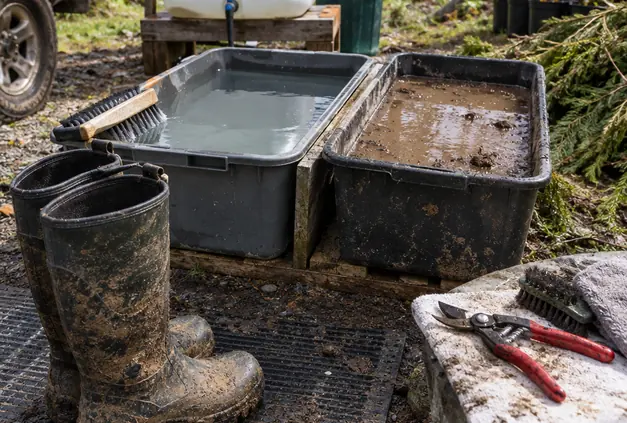
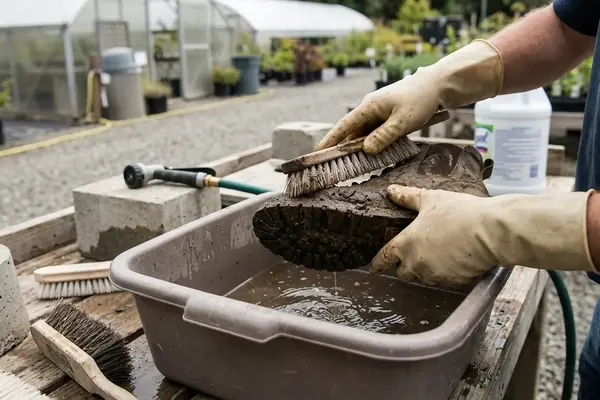
Public land stewards learned the method the hard way. Shallow chemical footbaths were once common at trailheads. Thick coastal clay neutralized the sodium hypochlorite within minutes, and the baths turned into mud puddles that trapped viable chlamydospores and passed them to the next set of boots. Crews replaced the baths with mandatory dry scraping using stiff nylon brushes, followed by an atomized alcohol spray. The lesson applies to every surface: disinfectant sprayed over caked soil reacts with the organic material and leaves the spores inside the clot shielded and alive.
Stage one: dry mechanical removal
At the parcel boundary, before anything gets wet, remove all visible mud and organic clots from:
- the lugs and arch of boot soles,
- vehicle wheel wells and tire treads,
- pruning blades, saw teeth and shovel faces.
A steel hoof pick works well for packed boot lugs. A stiff-bristle brush handles tool steel and tire faces. Work until bare rubber and bare metal show.
Stage two: chemical surface disinfection
Once surfaces are clean, apply either a 70% isopropyl alcohol spray or a freshly diluted 1:10 household bleach solution. Keep the surface wet for a minimum contact time of 60 seconds on bare metal tools and cleaned rubber soles. Mix bleach solutions on the day of use, wear gloves, and keep bleach away from alcohol and other cleaners. Alcohol suits pruning shears between cuts because it evaporates quickly and corrodes steel less.
Brush Before Spraying
Spraying alcohol or bleach onto unbrushed boots or shears wastes the disinfectant. The soil matrix absorbs it and insulates the chlamydospores inside. Scrape first, then spray.
Wet-season vehicle rules
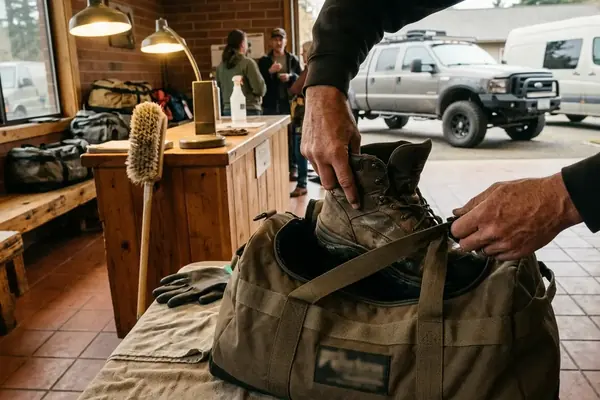
Along the Pacific coast, the rainy season typically runs from November through May, which is when foliar hosts sporulate and unpaved roads turn to mud. During this period, forestry and utility vehicles should stay on paved or crushed-rock surfaces at least 15 meters outside the drip line of symptomatic bay laurel canopies. Volunteers driving to SOD Blitz survey plots can apply the same rule: park on gravel, walk in, and brush down before getting back into the vehicle.
Screening Rhododendrons and Camellias Before They Go Near Oaks
Landscape managers investigating oak mortality on residential estates have traced new infections to recently planted camellia and viburnum hedges near upslope patio drains. The shrubs arrived looking healthy. Runoff from the drains carried inoculum downhill toward mature oaks. Since then, careful managers have run a site-grading review before introducing any foliar host near an established oak stand.
The difficulty lies in the nursery supply chain. Ornamentals often travel with suppressed or latent infections, and a plant can pass a quick inspection at the garden center while still carrying the pathogen. Homeowners with oaks therefore need a screening routine of their own.
What to look for before buying
Inspect rhododendron, camellia, viburnum and pieris stock for:
- dark, water-soaked lesions along leaf margins,
- blackened petioles where the leaf joins the stem,
- premature leaf drop or bare lower stems,
- waterlogged, sour-smelling container media.
Leave any plant showing these signs at the nursery and tell staff what you found.
Staging new plants in isolation
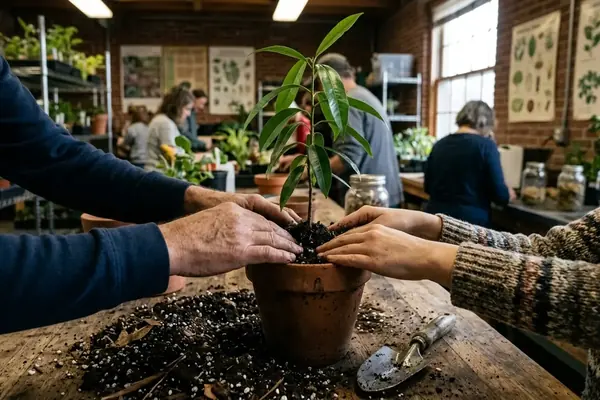
Hold newly acquired rhododendron, camellia, pieris and viburnum on raised gravel beds or impermeable tarps for 6 to 8 weeks, well away from native trees. Apply no fungicide during this period. Fungicides can suppress symptoms without eliminating the pathogen, and the purpose of staging is to let hidden lesions become visible. Repeat the inspection checklist before any plant leaves the staging area.
Timing matters. Visual screening detects active foliar blight in cool, moist weather between 15°C and 20°C. Summer heat above 28°C halts lesion expansion and can mask root-ball or vascular infections until autumn rains return. Plants staged through a heatwave should stay in isolation into the first cool, wet spell before they are cleared.
Raised Gravel Staging
A tarp or gravel pad keeps drainage water from the staging area out of garden soil. Place it on level ground downslope of any oak, and never under bay laurel.
Spacing and slope around oaks
Water moves the pathogen, so site hydrology determines where hosts can safely go. Plant susceptible ornamental foliar hosts downslope and at least 10 to 15 meters beyond the outer drip line and root protection zone of native coast live oaks, black oaks or tanoaks. Never place them upslope, inside the drip line, or where patio drains, downspouts or irrigation runoff will flow toward oak roots.
Keeping Prunings on the Parcel and Reading Quarantine Lines
Fuel-reduction work inside infested watersheds generates large volumes of bay laurel brush. Hauling that slash to municipal transfer stations means trucks carrying live inoculum along roads and through uninfested areas. Forestry coordinators running community projects have handled this by masticating the brush and spreading the chips on the parcel where it grew. In practice, the material never enters a transport corridor, so nothing spills along the route.
The default rule for uncertain material
When the infection status of pruned branches, raked bay leaves or downed wood is unknown, retain, chip or solarize it on the property of origin. For composting or solarizing to kill embedded chlamydospores, chip green debris into pieces smaller than 5 centimeters and keep internal pile temperatures above 55°C for at least 14 consecutive days. A long-stem compost thermometer pushed into the pile core gives the reading. Turn the pile if the edges stay cool, since spores at the margins survive when only the center heats.
Chips Stay Home
Chipping and heating debris where it was cut keeps inoculum within the infested area and off the roads, which no hauling arrangement can match.
Good practice versus legal restriction
Brushing boots and staging shrubs are voluntary sanitation habits. Quarantine rules carry legal force. Federal and state quarantine regulations govern the movement of host nursery stock, green waste and regulated oak firewood out of designated areas, as set out in the USDA APHIS Phytophthora ramorum quarantine guidelines. USDA APHIS and state departments of agriculture enforce these boundaries, which on this pathogen apply to regulated counties in California and the designated quarantine zones of Curry County, Oregon. Within them, interstate and intrastate movement of host nursery stock, soil and barked wood is restricted. County agricultural commissioners maintain the local maps that show where those lines fall.
Boundaries shift as new detections are confirmed, so a map consulted last year may no longer be accurate.
Check the map before anything leaves
Before loading any firewood, chipped mulch or bay foliage for transport off your parcel, open the current quarantine map from your county agricultural commissioner or USDA APHIS and confirm the status of both the origin and the destination. Until that check is done, leave every piece of uninspected plant material on the property where it grew.

Your Thoughts
No comments.
Leave a Comment